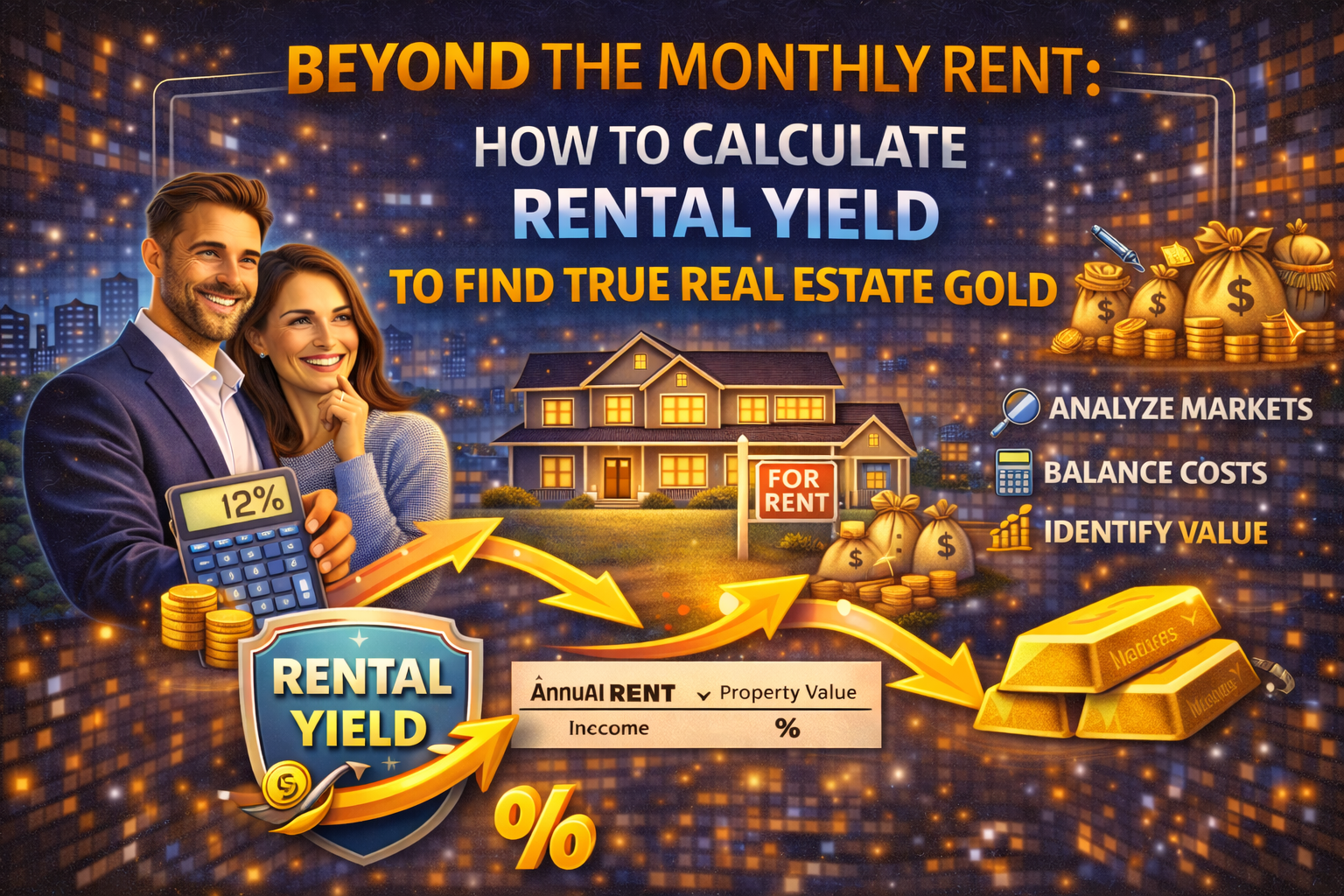
Stop guessing which investment properties make money. Learn how to calculate Rental Yield, understand net returns, and find the most profitable assets.
Table of Contents
I was chatting with a fellow investor named Shubham last week. He’s a sharp guy who spent years perfecting algorithmic trading for the Indian stock market before he ever looked at a physical deed. He told me that when he finally decided to diversify into property, he was shocked by how many people buy houses based on “vibes” or because the kitchen has nice granite.
“In the stock market, we look at the dividend payout. In real estate, we have to look at the Rental Yield,” he said. He was absolutely right.
If you’re buying a house for yourself, you care about the school district and the backyard. But if you’re looking for a real estate investment, you have to stop thinking like a homeowner and start thinking like a fund manager. A property might look beautiful in the property listings, but if the numbers don’t work, it’s just a very expensive liability. Mastering the art of calculating Rental Yield is the only way to ensure you aren’t just “buying a job,” but building actual wealth.
What Exactly is Rental Yield?
Let’s skip the high-level finance jargon. At its core, Rental Yield is the measure of how much cash a property produces relative to its cost. It’s essentially the “interest rate” your house is paying you.
When you look at different residential sales in your area, you’ll notice that some expensive houses actually have terrible returns, while a modest duplex in a blue-collar neighborhood might be a cash cow. This is why Rental Yield is the great equalizer. It allows you to compare a studio apartment in the city to a three-bedroom house in the suburbs on an even playing field.
Gross vs. Net: The Danger of Oversimplification
There are two ways to look at your return, and one of them is a trap.
Gross Rental Yield is the easy math. You take your annual rent and divide it by the purchase price. If you buy a house for $200,000 and it rents for $2,000 a month ($24,000 a year), your gross Rental Yield is 12%. It looks great on a spreadsheet, but it’s a lie.
You haven’t accounted for property taxes, homeowners insurance, maintenance, or vacancy. To find the truth, you need the Net Rental Yield. This is the amount left over after all the “gritty” costs of being a landlord are paid. I’ve seen investors brag about a high gross Rental Yield only to realize later that they are actually losing money every month because they bought in an area with high property taxes or aging infrastructure.
The Hidden Costs That Kill Your Return
When you’re doing your due diligence on a new property, you have to be pessimistic. I always tell my clients to budget for the “unseen.”
- Maintenance Fund: At least 1% of the home value annually.
- Property Management: Usually 8% to 10% of the rent.
- Vacancy Rate: Factor in at least one month of the house being empty per year.
- Landlord Insurance: It’s more expensive than standard homeowners insurance.
If your Rental Yield doesn’t account for these, you aren’t investing; you’re gambling.
Link to National Association of Realtors: Research and Statistics
Why Location Dictates Your Rental Yield
In the housing market, there is a constant tug-of-war between appreciation and yield.
In high-demand “A-class” neighborhoods with the best schools, property values are astronomical. Because the purchase price is so high, the Rental Yield is often very low—sometimes as low as 3% or 4%. You’re betting on the house becoming worth $200,000 more in ten years.
Conversely, in “C-class” neighborhoods, the houses are cheap. You can buy a property for $80,000 that rents for $1,200. Your Rental Yield here might be 15%. However, you’ll likely deal with more tenant turnover and higher maintenance costs. Choosing where to invest depends on whether you want a stable, low-maintenance asset or a high-octane cash flow machine.
How to Increase Your Rental Yield Without Raising Rent
If you already own a property and your Rental Yield is looking a little stagnant, you don’t always have to squeeze your tenants for more money. Sometimes the best way to improve your yield is by lowering your expenses.
Have you shopped around for better insurance lately? Have you challenged your latest home appraisal or tax assessment? Even a small $500 reduction in annual costs can significantly bump your Rental Yield over the long term.
Another strategy is “Value-Add.” Can you turn a large closet into a second bathroom? Can you finish a basement to create a separate commercial lease space for a home office? By increasing the utility of the property, you can justify a higher rent, which directly inflates your yield.
Link to Wikipedia: Real Estate Investment
The Role of Financing in Your Yield
If you are paying cash for a property, your Rental Yield is straightforward. But most of us use a mortgage lender.
Leverage changes the game. While your mortgage payment is an expense that lowers your net Rental Yield, it also allows you to control a much larger asset with less of your own cash. This is the difference between “Return on Investment” and “Cash-on-Cash Return.”
I’ve seen investors purposefully take a lower Rental Yield on a property because they were able to secure a rock-bottom mortgage interest rate. In their eyes, the debt was so cheap that the property was essentially paying for itself while they focused on other ventures.
Rental Yield and Multi-Family Properties
If you really want to see the power of this metric, look at multi-family properties. When you own a duplex or a four-plex, your economies of scale kick in.
You have one roof, one yard to mow, and one foundation to maintain, but you have four different checks coming in every month. This almost always results in a superior Rental Yield compared to a single-family home in the same zip code. This is why seasoned real estate investment pros eventually move away from houses and toward apartment buildings. It’s simply a more efficient way to squeeze every drop of profit out of a piece of land.
Avoiding “Yield Traps”
Be careful of the “Yield Trap.” This happens when you see a property with a staggering 20% Rental Yield in a town where the main industry just shut down.
A high Rental Yield is often a warning sign that the market is risky. If no one wants to buy houses in a certain area, the prices will drop, making the yield look fantastic on paper. But if you can’t find a reliable tenant to actually pay that rent, the yield is 0%. Always cross-reference your yield calculations with the local housing market demand and employment data.
Conclusion
At the end of the day, real estate is a game of patience and precision. You can’t control what the Fed does with interest rates, and you can’t control when a water heater decides to die. But you can control what you buy.
By obsessing over your Rental Yield during the search phase, you protect your future self from “buyer’s remorse.” You ensure that every dollar you put into a residential sales transaction is working as hard as it possibly can for you.
Real estate isn’t just about owning a piece of the earth; it’s about owning an income stream that lasts. Calculate your numbers, be honest about your expenses, and never buy a property just because it has a “good feeling.” Buy it because the Rental Yield says it’s a winner.
Are you currently looking at a property but aren’t sure if the numbers add up? What’s the biggest “hidden expense” you’ve run into as a landlord? Drop a comment below and let’s talk strategy!
FAQ Section
1. What is a “good” Rental Yield? It varies by market. In a high-growth city, a 4-5% net Rental Yield is standard. In more stable, cash-flow-heavy markets, investors often look for 8-10%. Generally, you want a yield that is significantly higher than what you could get in a “safe” investment like a high-yield savings account or bonds.
2. Does Rental Yield include property appreciation? No. Rental Yield only measures the cash income from the rent. Appreciation (the home increasing in value) is a separate part of your “Total Return.” Many investors are willing to accept a lower yield in exchange for higher expected appreciation.
3. How often should I recalculate my Rental Yield? I recommend doing it once a year. Your property taxes, insurance premiums, and market rent change over time. Keeping a close eye on your Rental Yield helps you decide when it’s time to raise the rent or perhaps sell the property and move your capital elsewhere.
4. Can I use Rental Yield to compare commercial and residential properties? Yes, but be careful. Commercial leases often have different structures (like Triple Net leases where the tenant pays the taxes and insurance). This can make a commercial Rental Yield look lower on paper but actually be more profitable because of lower owner expenses.
5. Why do property listings rarely show the Net Rental Yield? Most property listings only show the gross numbers because they don’t know your specific insurance costs or how you plan to manage the property. It’s the buyer’s job to dig into the “real” numbers and calculate the net yield for themselves.
