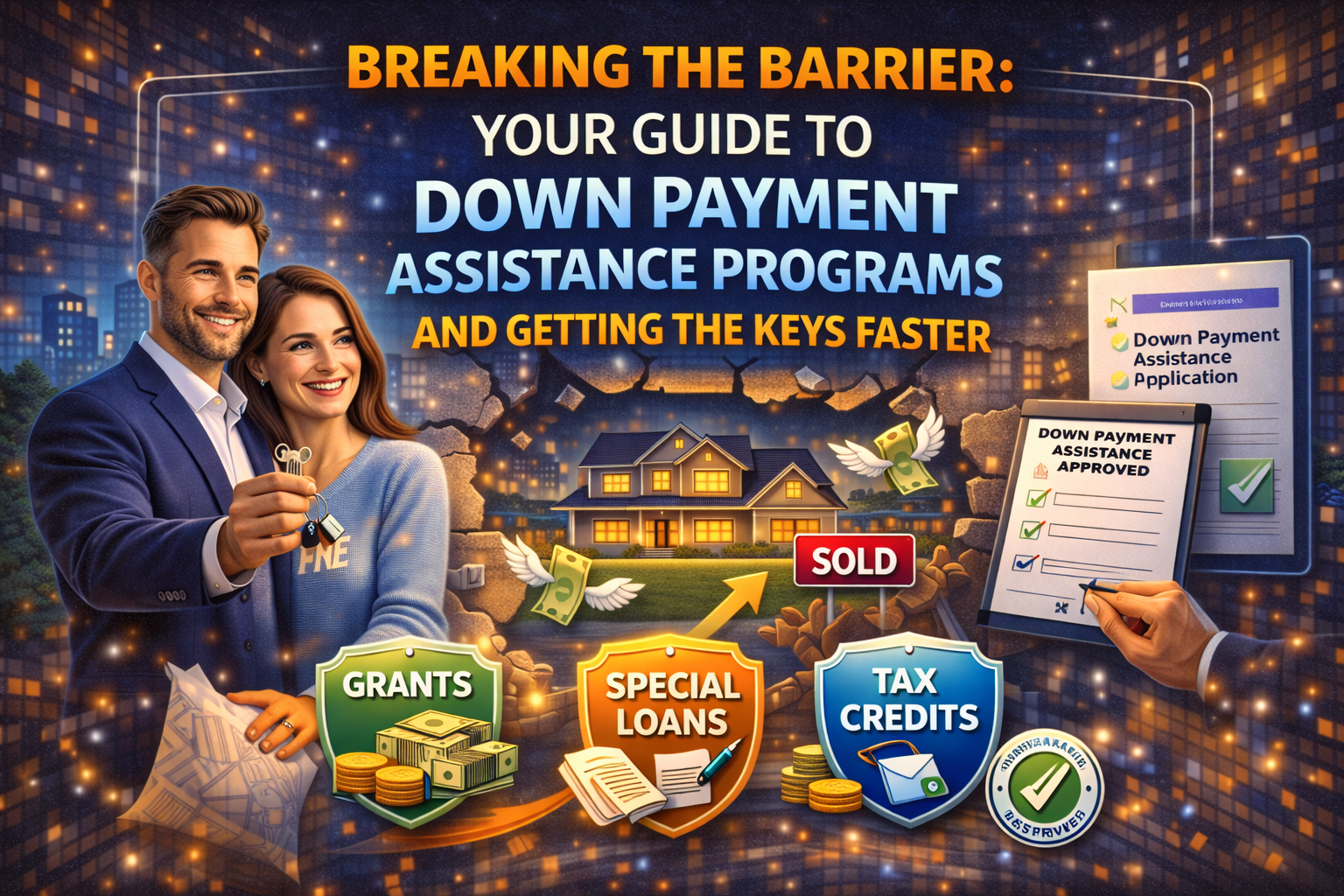
Stop letting a small savings account keep you from homeownership. Discover how Down Payment Assistance Programs can fund your purchase and lower your costs.
Table of Contents
I was chatting with a young couple, Priya and Amit, at a local cafe last week. They’ve been renting a cramped apartment for three years, watching the local housing market climb higher and higher. They have steady jobs and great credit, but every time they look at their savings, they feel a pit in their stomach. The idea of scraping together $40,000 or $50,000 just to get in the door felt like a mountain they couldn’t climb.
I told them what I tell everyone who feels stuck: the “20% down” rule is the biggest myth in real estate.
If you’re waiting until you have a massive pile of cash, you might be waiting forever while home prices continue to outpace your savings. This is where Down Payment Assistance Programs come into play. These are the industry’s best-kept secrets, designed specifically to bridge the gap for people who can afford a monthly mortgage but just need a helping hand with the upfront “buy-in.” Let’s pull back the curtain on how these state and local initiatives actually work.
What Are Down Payment Assistance Programs, Exactly?
In plain English, Down Payment Assistance Programs are grants or low-interest loans provided by state housing finance agencies, non-profits, or local municipalities. They are intended to help homebuyers—especially those looking for their first primary residence—cover the initial costs of a purchase.
Think of it as a specialized financial boost. Some of these are “silent seconds,” which are second mortgages that you don’t have to pay back until you sell the house or finish your primary loan. Others are outright grants that never need to be repaid. When you utilize Down Payment Assistance Programs, you aren’t just getting cash; you’re getting a seat at the table in a competitive market where cash is king.
The Different Flavors of Assistance
Not all help looks the same. Depending on where you live and what your specific financial profile looks like, you might qualify for a few different types of Down Payment Assistance Programs.
- Forgivable Grants: This is the “holy grail.” The state gives you a set amount of money, and as long as you live in the home for a certain period (usually 5 to 10 years), you never have to pay it back.
- Deferred Payment Loans: You get the money upfront, but there are no monthly payments. You only pay it back when you sell the home, refinance, or reach the end of your mortgage term.
- Low-Interest Loans: These are second mortgages with very low interest rates that you pay back alongside your primary mortgage.
- Matched Savings Programs: Often called Individual Development Accounts (IDAs), these programs match the money you save dollar-for-dollar (or more) to be used for your home purchase.
Why Your Mortgage Lender Is Your Best Ally
You don’t just apply for these programs on a random website. Most Down Payment Assistance Programs require you to work with a “participating lender.” These are banks and credit unions that have been vetted and approved by the state to handle these specific funds.
When you sit down for your initial mortgage pre-approval, ask your loan officer directly about available Down Payment Assistance Programs. A proactive lender will look at your income, your credit score, and your target neighborhood to see which pots of money you can dip into. I’ve seen buyers walk into a closing with only $2,000 of their own money because their lender was a pro at stacking these assistance options.
Link to National Association of Realtors: Home Buyer and Seller Trends
Eligibility: Are You “First-Time” Enough?
There’s a common misconception that Down Payment Assistance Programs are only for twenty-somethings buying their very first home. In the eyes of the government, a “first-time buyer” is often defined as anyone who hasn’t owned a primary residence in the last three years.
If you sold a house four years ago and have been renting ever since, congratulations—you’re likely eligible for Down Payment Assistance Programs again. There are also specific programs for “community heroes,” such as teachers, firefighters, police officers, and healthcare workers. These professions often get access to deeper pools of funding with even more flexible repayment terms.
Navigating the Income and Credit Score Hurdles
Because these are public or non-profit funds, they do come with strings attached. Most Down Payment Assistance Programs have income limits based on the “Area Median Income” (AMI). If you make too much money, you might be disqualified, as the funds are prioritized for those who truly need the boost.
Additionally, you’ll usually need a minimum credit score—often around 620 to 640—to qualify. The state wants to ensure that if they are giving you a grant or a loan, you have a track record of managing your debt-to-income ratio responsibly. It’s about creating sustainable homeownership, not just getting people into houses they can’t afford long-term.
Link to Wikipedia: First-time buyer
The Trade-Offs: Is There a Catch?
I’m a big believer in being candid. While Down Payment Assistance Programs are fantastic, they aren’t “free money” without consequences. Sometimes, the interest rate on your primary mortgage might be slightly higher (maybe 0.25% to 0.5%) if you use assistance.
You also have to factor in your closing costs. While the assistance might cover your 3.5% down payment for an FHA loan, you still have to pay for the home appraisal, the title search, and the home inspection. However, many Down Payment Assistance Programs are now being expanded to cover these closing costs as well, essentially allowing for a “zero-down” experience.
Real-Life Example: From Renter to Owner
I worked with a teacher named Marcus last year. He was looking at a charming condo priced at $250,000. Between his student loans and car payment, his savings were modest. We found a state-run program that provided $10,000 in Down Payment Assistance Programs as a forgivable grant.
Because he didn’t have to drain his entire savings account for the down payment, he had enough cash left over to cover his move-in costs and buy some furniture. Without those Down Payment Assistance Programs, Marcus would still be paying rent today, watching his landlord build equity instead of building his own.
Preparing for the Application Process
If you think you might want to use Down Payment Assistance Programs, start preparing now. Many of these programs require you to complete a homebuyer education course. These are usually 4 to 8 hours long and can often be done online.
These courses teach you the “un-sexy” parts of homeownership: how to manage a budget, how to maintain a property, and how to avoid predatory lending. Completing this course is often a mandatory box you have to check before the state will release any Down Payment Assistance Programs funds to your escrow account.
Conclusion
The path to your first front door doesn’t have to be paved with years of grueling, extreme frugality. If you have the income to support a mortgage but are just struggling with the initial hurdle of the entry cost, Down Payment Assistance Programs can be the bridge that changes your life.
Don’t let the fear of a small bank account stop you from browsing property listings. Take the time to call a local lender, look up your state’s housing finance agency, and see what Down Payment Assistance Programs are waiting for you. Homeownership is the most powerful tool for building generational wealth—make sure you’re using every resource available to get your foot in the door.
Have you looked into assistance in your area yet? What’s been the biggest hurdle for you so far? Drop a comment below and let’s figure out how to get you into that first home!
FAQ Section
1. Do I have to pay back Down Payment Assistance Programs? It depends on the specific program. Some are grants that are completely forgiven after you live in the home for a certain number of years. Others are “silent” second mortgages that you pay back only when you sell, refinance, or finish paying off your main mortgage.
2. Can I use these programs with an FHA loan? Yes! In fact, many Down Payment Assistance Programs are specifically designed to work alongside FHA or VA loans. They help cover that 3.5% minimum requirement that FHA loans demand, making the entry cost even lower.
3. Are Down Payment Assistance Programs only for houses in bad neighborhoods? Not at all. While some “census tract” programs target specific areas for revitalization, most state-level Down Payment Assistance Programs can be used for any residential sales that fall within the price limits of the program, regardless of the neighborhood.
4. How long does it take to get approved for assistance? The approval for the assistance usually happens simultaneously with your mortgage underwriting. However, it can add an extra week or two to your closing timeline because the state agency has to review your file and approve the funds before you can sign the final papers.
5. Can I use more than one program at a time? In many cases, yes! This is called “stacking.” You might get a grant from the state and a smaller, local low-interest loan from your city. A savvy real estate agent and lender can help you combine multiple Down Payment Assistance Programs to maximize your savings.
