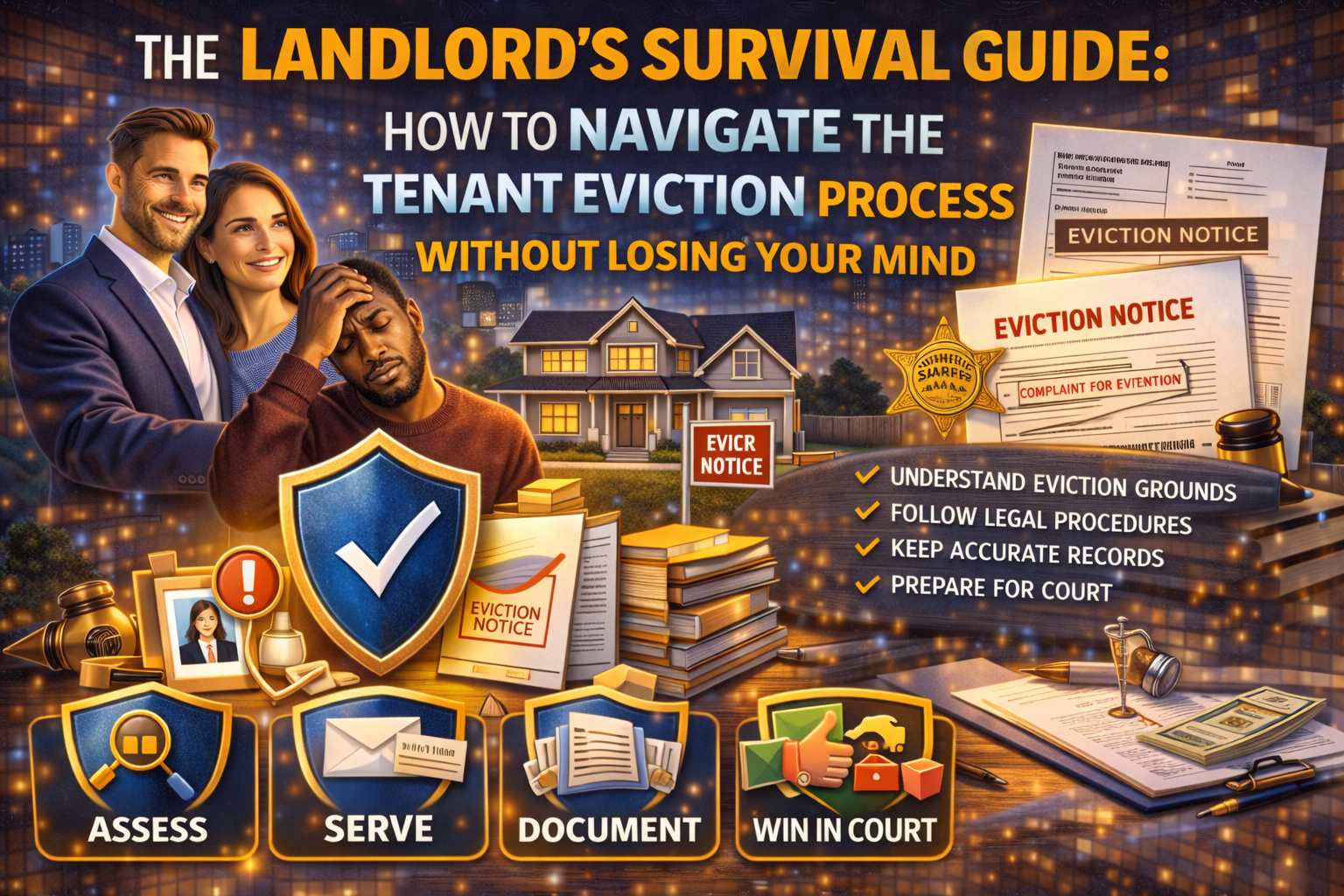
Dealing with a difficult renter? Learn how to navigate the Tenant Eviction Process legally and effectively to regain control of your rental property.
Table of Contents
I remember a mentor of mine once told me that you aren’t truly a real estate investor until you’ve had to ask someone to leave. At the time, I thought he was being cynical. Then, I had my first experience with a tenant who decided that paying rent was “optional” for three months straight. The pit in my stomach was real. The stress of potentially losing thousands in mortgage payments while someone else lived in my house for free was enough to keep me up at night.
The truth is, the Tenant Eviction Process is easily the most dreaded part of property management. It feels personal, it’s legally dense, and if you mess up one tiny detail, a judge can throw your entire case out, forcing you to start from scratch.
However, if you approach it as a professional business procedure rather than an emotional battle, you can navigate it successfully. Whether you are dealing with a non-payment issue or a serious lease violation, understanding the Tenant Eviction Process is vital to protecting your investment. Let’s pull back the curtain on how to handle this difficult situation with grace and legal precision.
The Most Important Rule: Never, Ever Self-Help
Before we talk about how to do it right, we have to talk about how to do it wrong. I’ve seen landlords get so frustrated that they change the locks, cut off the utilities, or remove the front door while the tenant is at work. In the industry, we call this a “self-help” eviction, and it is a one-way ticket to a massive lawsuit.
Regardless of how much rent they owe, you cannot force someone out physically. The Tenant Eviction Process must go through the court system. If you try to take matters into your own hands, the tenant could end up suing you for more than the rent they owe, and a judge will likely take their side. Stay calm, stay professional, and stick to the legal roadmap.
Step 1: The Formal Notice to Quit
Every successful Tenant Eviction Process begins with a piece of paper. You cannot just call them or send a frustrated text. You must serve a formal “Notice to Quit” or a “Pay or Quit” notice.
This document tells the tenant exactly why they are in trouble and gives them a specific window—usually 3 to 14 days depending on your state—to fix the problem or move out. In many residential sales and rental markets, this notice is enough to spark action. Sometimes, the tenant just needed to know you were serious. If they pay the full amount within that window, the Tenant Eviction Process stops immediately. If they don’t, you move to the next phase.
Step 2: Filing the Lawsuit (Unlawful Detainer)
If the notice period expires and the tenant is still there (and still hasn’t paid), it’s time to head to the courthouse. You will file what is known as an Unlawful Detainer.
This is the official start of the legal Tenant Eviction Process. You’ll pay a filing fee, and a process server or local sheriff will deliver the summons to the tenant. It is absolutely vital that your residential lease agreement is attached and that your records are perfect. If you’ve been “slashing” the rent in verbal side-deals, it’s going to come back to haunt you here. The court only cares about what is written in black and white.
Link to National Association of Realtors: Landlord-Tenant Resources
Step 3: The Court Hearing
Once the tenant is served, they have a chance to respond. If they don’t, you might win by default. If they do, you’ll head to a hearing.
During this stage of the Tenant Eviction Process, you need to be the most organized person in the room. Bring your payment ledger, copies of all correspondence, and photos if the eviction is due to property damage. I’ve seen real estate investment pros lose cases because they couldn’t prove exactly when the last payment was made. Don’t be that guy. If the judge finds in your favor, they will issue a “Judgment for Possession.”
Step 4: The Writ of Possession
Winning in court doesn’t mean you can go change the locks that afternoon. You still have to wait for the court to issue a Writ of Possession.
This document is given to the local sheriff, who will then go to the property and post a final notice on the door. This is the last step in the Tenant Eviction Process. It tells the tenant they have a very short window—often just 24 to 72 hours—to vacate. If they are still there when the sheriff returns, the sheriff will physically remove them and their belongings.
The “Cash for Keys” Alternative
I’ll be honest with you: the formal Tenant Eviction Process can take months and cost thousands in legal fees. This is why many experienced landlords use a strategy called “Cash for Keys.”
Instead of fighting in court, you offer the tenant a small sum of money—perhaps $500 or $1,000—to move out by a specific date and leave the property in “broom-clean” condition. It feels like rewarding bad behavior, but from a purely financial perspective, it’s often much cheaper than a full-blown Tenant Eviction Process. You get your property back faster, you avoid legal fees, and you can get a new, paying tenant in much sooner to restore your rental yield.
Handling Abandoned Property
What happens if the tenant leaves but leaves behind a mountain of junk? You can’t just throw it in the dumpster immediately.
Most states have specific laws within the Tenant Eviction Process regarding “abandoned property.” You may have to store it for a set period and notify the former tenant where they can pick it up. If you just toss their belongings, you could be held liable for the value of that property. Check your local statutes carefully; this is a common “trap” that catches many first-time homebuyer landlords off guard.
Why Screening is the Best Defense
The best way to handle the Tenant Eviction Process is to never have to start it in the first place. This brings us back to the importance of rigorous screening tenants.
If you do your homework upfront—checking credit scores, verifying income, and calling previous landlords—you drastically reduce the odds of ending up in housing court. Most evictions are predictable. If someone has a history of being removed from properties, they will likely do it again. A solid Tenant Eviction Process starts with a “No” at the application stage.
The Financial Fallout
Even a “smooth” Tenant Eviction Process is going to hurt your bottom line. You have to account for:
- Lost rent during the months of non-payment.
- Court filing fees and attorney costs.
- Repair costs for any “revenge damage” the tenant might have caused.
- Cleaning and re-marketing expenses to find a new occupant.
This is why having a healthy “reserve fund” is so important for any real estate investment. You should always have enough cash on hand to cover at least three months of expenses without any rental income.
Conclusion
No one likes the Tenant Eviction Process. It is the “ugly” side of being a landlord that no one talks about at the networking mixers. It is stressful, expensive, and time-consuming.
But it is also a necessary tool to protect your rights as a property owner. If you follow the law to the letter, stay professional, and keep impeccable records, you will get through it. Regaining control of your property allows you to find a tenant who actually respects your home and your contract. Don’t let one bad experience sour you on the world of real estate; just let it make you a sharper, more disciplined manager.
Have you ever had to go through a formal eviction? What was the biggest lesson you learned from the experience? Drop a comment below and let’s help each other stay out of the courtroom!
FAQ Section
1. How long does the Tenant Eviction Process typically take? It depends entirely on your local jurisdiction. In “landlord-friendly” states, it might take 30 to 45 days. In more “tenant-friendly” areas, a contested Tenant Eviction Process can stretch for six months or longer, especially if the court system is backed up.
2. Can I evict a tenant for no reason? If the tenant is on a month-to-month lease, you can usually terminate the agreement with 30 to 60 days’ notice without giving a specific reason. However, if they are in the middle of a fixed-term residential lease agreement, you must have a “just cause,” such as non-payment or a lease violation, to start the Tenant Eviction Process.
3. Do I need a lawyer for the Tenant Eviction Process? While you can technically represent yourself in small claims or housing court, hiring an attorney is highly recommended. The laws are incredibly specific, and a single procedural error can result in your case being dismissed, causing the Tenant Eviction Process to start all over again.
4. What is a “Stay of Execution”? A stay of execution is a court order that temporarily pauses the Tenant Eviction Process. A judge might grant this if the tenant can prove they have a medical emergency or another extreme hardship, giving them a little extra time to find a new place to live.
5. Can a tenant stop the Tenant Eviction Process by paying late? In many states, if the tenant pays the full amount owed (including late fees and court costs) before the final judgment, the Tenant Eviction Process must stop. This is known as the “Right to Reinstate.” Check your local laws to see if this applies in your area.
