Stop waiting years to save for your next down payment. Learn how the BRRRR Method allows you to recycle capital and scale your rental portfolio fast.
Table of Contents
I was grabbing a late-night coffee with a friend named Arjun a few months ago. He’s a guy who spent years obsessing over the Indian stock market, specifically looking at Nifty 50 trends, before he finally decided to touch a piece of physical land. He had saved up enough for one down payment, bought a decent duplex, and then hit a wall. “I’m tapped out,” he told me. “It’ll take me another four years to save up for the next one. How do people own twenty of these things?”
I told him the same thing I tell every frustrated investor: you don’t need new money for every deal; you just need to learn the BRRRR Method.
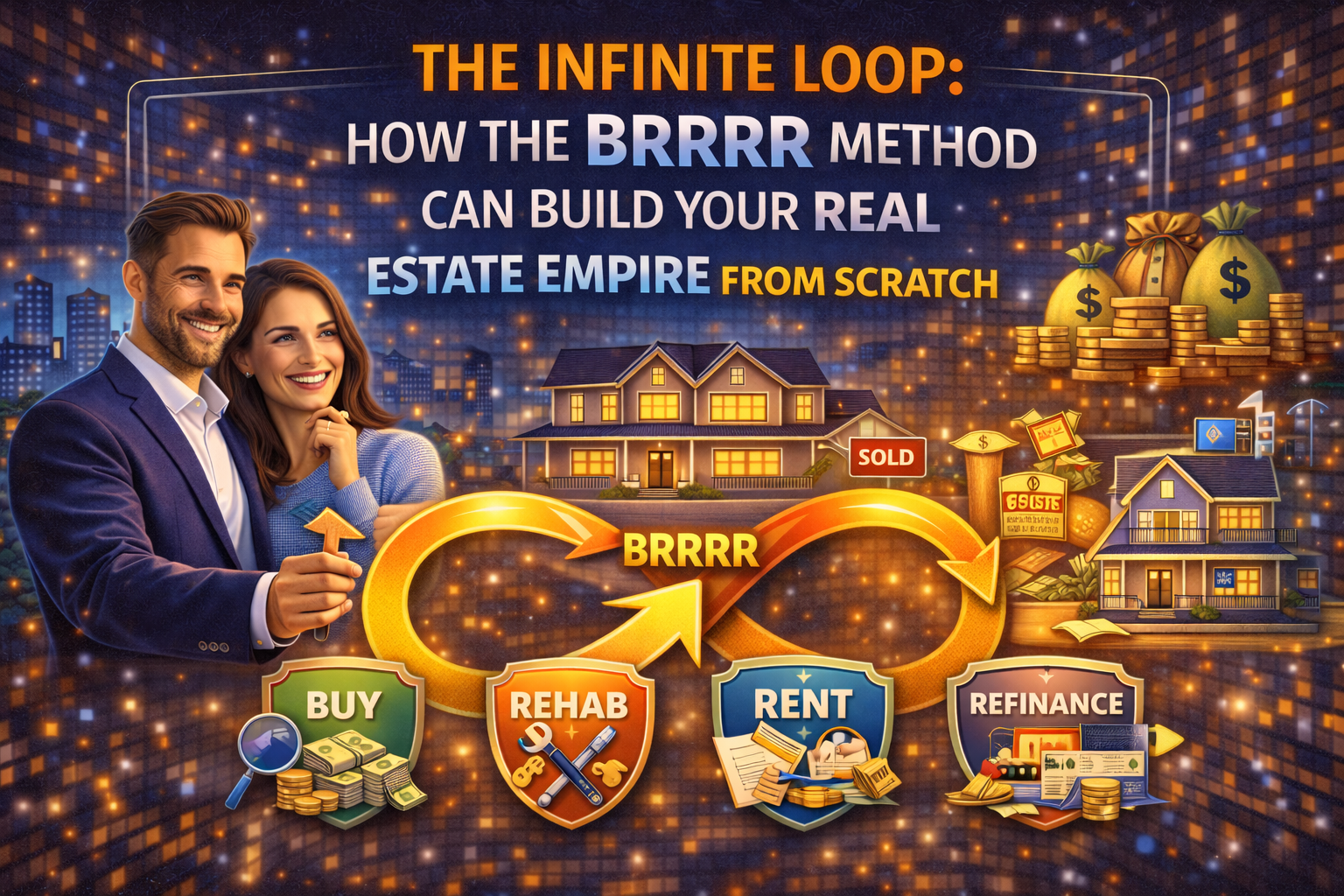
If you aren’t familiar with the acronym, it stands for Buy, Rehab, Rent, Refinance, Repeat. It is essentially the “cheat code” of the real estate world. Instead of leaving your hard-earned cash buried in the walls of a single property, you use a specific strategy to pull that money back out and move it into the next transaction. It is the most powerful way to scale a portfolio without having a multi-million dollar inheritance. Let’s break down the mechanics of how the BRRRR Method actually works in the wild.
Buy: Finding the Diamond in the Rough
The first step of the BRRRR Method is where most people get cold feet. You aren’t looking for a “move-in ready” dream home with perfect staging. You are looking for the house that smells like wet dog and has lime-green carpet from 1974.
You have to buy at a discount. In the world of residential sales, this usually means looking for distressed sellers or properties that won’t qualify for traditional financing. You are looking for a house where you can add immediate value. If you buy a house for what it’s already worth, the BRRRR Method falls apart instantly. You need to buy cheap enough that even after you fix it up, you still have “equity room” to play with.
Rehab: Adding Value Where It Counts
Once you have the keys, the clock is ticking. Every day the house is empty is a day you are paying interest and taxes without any income. The goal of the rehab phase in the BRRRR Method isn’t to create a masterpiece for a design magazine. It’s to make the home durable, safe, and attractive to the average renter in your housing market.
- Focus on the big wins: Fresh neutral paint, durable LVP flooring, and updated light fixtures.
- Don’t over-improve: Don’t put Carrara marble in a neighborhood where the average rent is $1,200.
- System checks: Ensure the HVAC, roof, and plumbing are solid. This prevents “maintenance bleed” later on.
Rent: Securing the Cash Flow
Lenders hate empty houses. If you want to move to the next step of the BRRRR Method, you need a signed lease and a security deposit in the bank.
Finding a high-quality tenant is your top priority here. You want someone who will treat the property with respect and pay on time, every time. This rental income is what “seasons” the deal. It proves to the bank that the property is a viable, income-generating real estate investment. Without a tenant, you are just a guy with a renovated house and a high-interest hard money loan.
Link to National Association of Realtors: Rental Market Trends
Refinance: The Moment of Truth
This is where the magic happens. After the property has been renovated and rented, you approach a mortgage lender for a cash-out refinance.
Ideally, the house is now worth significantly more than what you paid for it plus the cost of the repairs. The bank will typically lend you 75% to 80% of the new appraised value. If you’ve done the BRRRR Method correctly, that 80% loan should be enough to pay back your original purchase price and your rehab costs.
Suddenly, you own a renovated, cash-flowing rental property, but you have $0 of your own money left in the deal. Your capital has been “recycled.”
The Importance of the Home Appraisal
Your entire exit strategy hinges on the home appraisal. If the appraiser doesn’t see the value you’ve added, you might end up with “trapped” equity. This is why many investors using the BRRRR Method provide the appraiser with a “packet” detailing all the upgrades made, including before-and-after photos and receipts. You want to make it as easy as possible for them to justify that higher valuation.
Repeat: Scaling the Empire
This is the final “R” in the BRRRR Method, and it’s the most exciting one. Since you’ve pulled your original capital back out through the refinance, you can now take that exact same pile of cash and use it as a down payment on property number two.
Then you do it again for property number three. And property number four.
This loop is how small-time landlords turn into massive real estate investment moguls. The BRRRR Method allows you to grow exponentially rather than linearly. You aren’t limited by how much you can save from your day job; you are only limited by how many undervalued properties you can find.
Link to Wikipedia: Real Estate Investing Strategies
The Risks: What Could Go Wrong?
I wouldn’t be a responsible blogger if I didn’t tell you that the BRRRR Method comes with some serious teeth. It is a high-octane strategy, and if you aren’t careful, you can get burned.
- Rehab Overruns: If your $20,000 kitchen ends up costing $40,000, your equity disappears.
- Appraisal Gaps: If the market dips and the home appraisal comes in low, you won’t be able to pull all your money out. You’ll be “stuck” in the deal.
- Interest Rate Spikes: If mortgage interest rates climb significantly while you are doing the rehab, your final monthly payment might be too high to cash flow.
Success with the BRRRR Method requires a “margin of safety.” You have to be conservative with your numbers and always have a backup plan.
Why Management Matters
Once you have three or four properties using the BRRRR Method, you can no longer manage them on the back of a napkin. You need a system. This is where professional property management or a robust database comes in.
You need to track your rental yield, your maintenance tickets, and your lease renewals. I’ve seen great investors fail because they were brilliant at the “Buy and Rehab” part but terrible at the “Rent” part. If your tenants stop paying, the whole BRRRR Method deck of cards collapses.
Conclusion
The BRRRR Method isn’t a “get rich quick” scheme. It is hard, dusty, and often stressful work. It involves dealing with contractors, navigating bank red tape, and scouring property listings for months to find one good deal.
But for those who are willing to put in the effort, it is the single most effective path to wealth in the real estate world. It turns your savings into a reusable tool rather than a one-time spend. If you are tired of the slow crawl of traditional investing, it might be time to take the plunge into your first BRRRR deal.
Are you ready to stop saving and start recycling your capital? What’s the biggest thing holding you back from your first rehab project? Drop a comment below and let’s talk strategy!
FAQ Section
1. How much money do I need to start the BRRRR Method? While the goal is to have $0 in the deal at the end, you need cash or a hard money loan to start. Typically, you’ll need enough for the down payment and the initial rehab costs. Many investors using the BRRRR Method start with around $30,000 to $50,000, depending on their local market.
2. How long does the “Refinance” step take? Most conventional lenders require a “seasoning period” of at least six months before they will let you do a cash-out refinance based on the new appraised value. Some portfolio lenders might let you do it sooner, but six months is the industry standard for the BRRRR Method.
3. Can I use the BRRRR Method for commercial real estate? Absolutely. In fact, it’s even more common with commercial leases and apartment buildings. Since commercial value is based on net operating income (NOI), increasing the rents and lowering expenses can lead to massive “forced appreciation,” allowing for huge cash-out refinances.
4. What if the house doesn’t appraise for enough to pull my money out? This is known as a “partial BRRRR.” You might still have $5,000 or $10,000 left in the deal. While it’s not a “perfect” BRRRR Method execution, it’s still usually a better return on investment than a traditional 20% down payment purchase.
5. Do I need a special real estate agent for this? Yes. You need an agent who understands investment properties and can help you run “after-repair value” (ARV) comps. A traditional agent who only focuses on pretty houses might not understand the specific math required for a successful BRRRR Method deal.
