
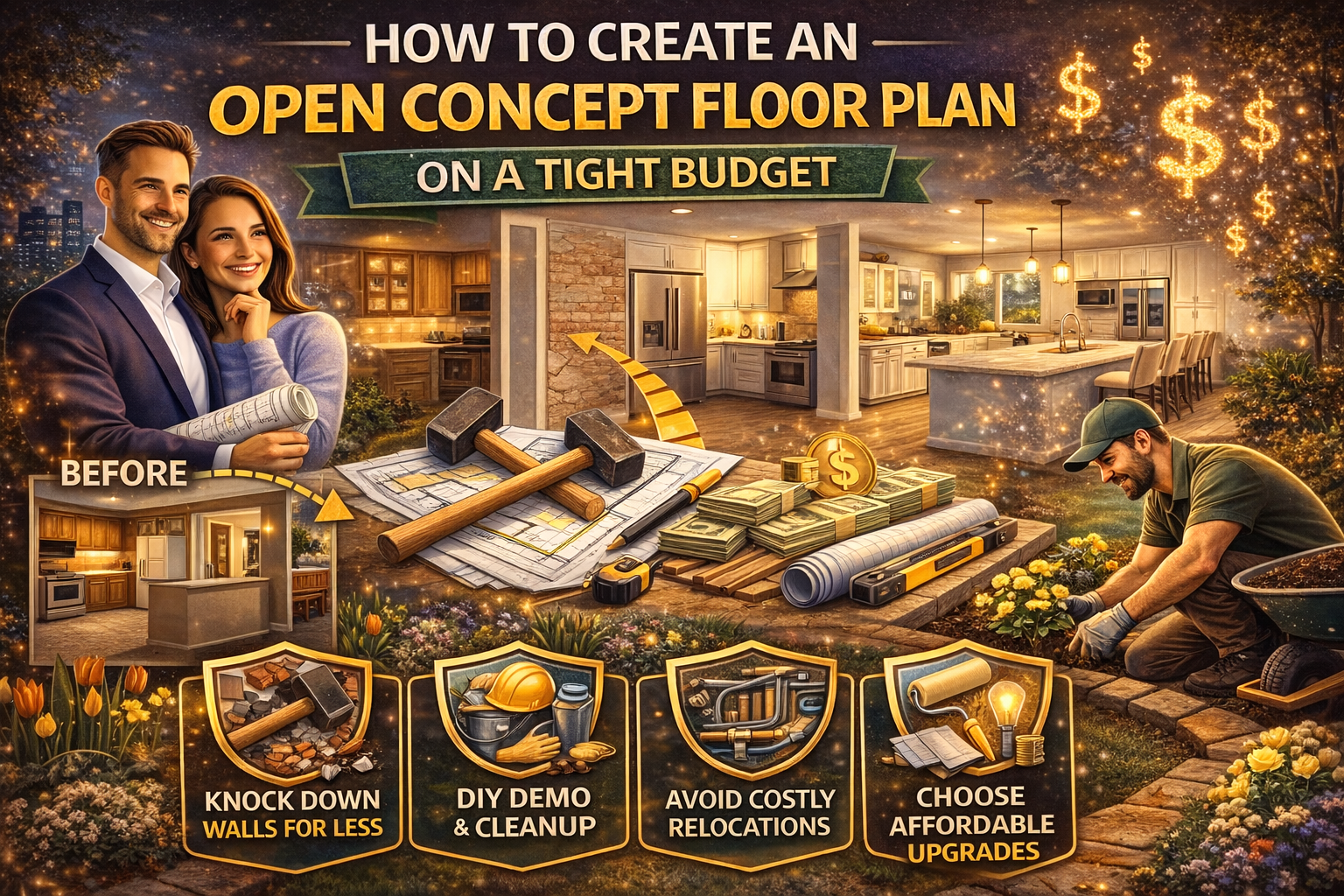
Learn how to design an Open Concept Floor Plan on a tight budget with smart remodeling ideas that boost home value, space, and buyer appeal.
Table of Contents
Introduction
Many older homes were built with a maze of separate rooms. Small kitchens, closed dining areas, and narrow hallways were once considered normal. Today, buyers often prefer bright, connected living spaces where the kitchen, dining, and living room flow together naturally.
That’s why the Open Concept Floor Plan has become one of the most desirable home layouts in modern real estate.
But homeowners often assume achieving that look requires a massive renovation budget. In reality, you can create an Open Concept Floor Plan without tearing down half the house or spending tens of thousands of dollars.
With smart design choices, selective wall removal, and creative space planning, even modest homes can feel dramatically larger and more connected.
Whether you’re preparing your home for sale or simply want to modernize your living space, this guide will walk through practical ways to create an Open Concept Floor Plan on a budget while improving functionality and property value.
Why Buyers Love an Open Layout
Homebuyers consistently rank open layouts among the most attractive design features when searching for properties.
An Open Concept Floor Plan allows natural light to travel further through the home, making spaces feel brighter and larger.
According to the National Association of Realtors, modern buyers often prioritize layouts that allow easier interaction between kitchen, dining, and living areas.
This layout style also benefits homeowners who enjoy entertaining guests, supervising children while cooking, or simply enjoying a more spacious environment.
Because of these advantages, homes with an Open Concept Floor Plan often attract more buyer interest and stronger offers in competitive housing markets.
What Defines an Open Concept Floor Plan
An Open Concept Floor Plan removes unnecessary barriers between key living spaces. Instead of separate rooms divided by walls, the layout blends areas together while still maintaining functional zones.
Common spaces connected in an open layout include:
• Kitchen and dining area
• Kitchen and living room
• Dining and living space
• Entryway and living area
The goal is not to eliminate structure entirely but to create visual flow.
The design concept relates closely to Open plan, which focuses on maximizing shared living spaces within residential architecture.
Budget-Friendly Ways to Create an Open Layout
Major structural changes can be expensive, but several affordable strategies can help achieve an Open Concept Floor Plan without a full renovation.
Remove Non-Load-Bearing Walls
Some interior walls exist only to divide space, not support the structure of the home.
Removing these walls is often the most effective way to create an Open Concept Floor Plan.
Before demolition, a contractor or structural engineer should confirm whether a wall is load-bearing.
If the wall is purely decorative or partition-based, removal can dramatically improve space flow at a relatively modest cost.
Create a Kitchen Pass-Through
If removing an entire wall isn’t practical, a pass-through window between rooms can achieve a similar effect.
A large opening between the kitchen and living room visually connects the spaces while keeping structural elements intact.
Many homeowners achieve an Open Concept Floor Plan feel simply by installing a wide pass-through with a countertop or breakfast bar.
This upgrade improves both functionality and visual openness.
Widen Doorways
Another surprisingly effective trick involves expanding narrow doorways into wider openings.
Traditional homes often have small door frames separating rooms. By widening those openings, homeowners can achieve a partial Open Concept Floor Plan without structural demolition.
This approach works especially well between dining rooms and living rooms.
Design Tricks That Mimic an Open Concept Floor Plan
Even without construction, interior design techniques can make a home feel more open.
These strategies help create the appearance of an Open Concept Floor Plan while staying budget friendly.
Use Consistent Flooring
Flooring transitions between rooms can visually divide spaces.
Installing the same flooring throughout connected areas creates continuity and strengthens the feel of an Open Concept Floor Plan.
Popular choices include:
• Hardwood flooring
• Luxury vinyl plank
• Large tile formats
This simple design choice makes the home feel larger and more cohesive.
Improve Natural Lighting
Light plays a powerful role in how spacious a home feels.
Removing heavy curtains, installing brighter fixtures, or adding mirrors can enhance the illusion of an Open Concept Floor Plan.
Light flowing across multiple spaces helps connect them visually.
Choose Low-Profile Furniture
Bulky furniture can break the sense of openness.
Instead, homeowners trying to create an Open Concept Floor Plan should choose furniture that maintains sightlines across the room.
Open shelving, minimalist seating, and lower-profile sofas can help preserve the airy feeling.
Budget Remodeling Projects That Increase Home Value
For homeowners planning to sell, improving layout can increase property appeal.
An Open Concept Floor Plan often makes homes feel newer, even if the structure is decades old.
Budget remodeling ideas that complement open layouts include:
• Kitchen island installation
• Updated lighting fixtures
• Neutral interior paint
• Matching flooring across rooms
• Removing outdated partitions
These projects not only support an Open Concept Floor Plan but also strengthen home resale value.
For more context about renovation strategies, see the overview of Home improvement which explains how structural updates influence property value.
Structural Considerations Before Removing Walls
While opening spaces can be exciting, safety must always come first.
Before attempting to create an Open Concept Floor Plan, homeowners should evaluate structural factors.
Load-bearing walls support the weight of the roof or upper floors. Removing them requires installing beams or supports.
Electrical wiring, plumbing lines, and HVAC systems may also run through interior walls.
Professional inspections ensure your Open Concept Floor Plan project doesn’t compromise the structural integrity of the home.
Real Estate Benefits of an Open Concept Floor Plan
In many housing markets, homes with open layouts sell faster than properties with traditional compartmentalized designs.
There are several reasons why buyers favor an Open Concept Floor Plan.
Better natural lighting
Improved social interaction
Flexible furniture arrangements
Modern design appeal
Real estate investors often prioritize converting older layouts into an Open Concept Floor Plan because the transformation can significantly improve marketability.
Even modest layout adjustments can create a strong visual impact during home showings.
Cost Expectations for Budget Projects
Creating an Open Concept Floor Plan doesn’t have to mean a $50,000 renovation.
Budget-friendly improvements might include:
Wall removal: $1,500 – $5,000
Doorway expansion: $500 – $2,000
Kitchen pass-through: $800 – $3,000
Lighting upgrades: $200 – $1,000
Compared with full home remodeling, these improvements can deliver a major design transformation at a manageable cost.
Common Mistakes When Creating Open Layouts
While the idea of open living spaces is appealing, certain mistakes can undermine the design.
Removing too many walls can eliminate useful storage or privacy.
Noise also travels more easily in open layouts, which some homeowners overlook.
Maintaining visual zones within an Open Concept Floor Plan helps preserve functionality.
Area rugs, furniture placement, and lighting can subtly define different spaces while maintaining openness.
Conclusion
Creating a modern living space doesn’t require a massive renovation budget. With thoughtful planning and selective upgrades, homeowners can achieve the look and functionality of an Open Concept Floor Plan without major structural work.
From widening doorways to improving lighting and removing non-load-bearing walls, several affordable strategies can transform how a home feels.
For sellers, these upgrades can increase buyer appeal and improve property value. For homeowners planning to stay long term, the improved flow and spaciousness can dramatically enhance everyday living.
A well-designed Open Concept Floor Plan balances openness with practicality, creating a home that feels both welcoming and functional.
FAQ Section
What is an Open Concept Floor Plan
An Open Concept Floor Plan is a home layout where major living spaces such as the kitchen, dining room, and living room are connected without traditional interior walls.
Does removing walls increase home value
Yes. Opening interior spaces can improve buyer appeal and make homes feel larger, which can increase resale value in many housing markets.
How much does it cost to create an open layout
Costs vary depending on structural changes. Simple wall removal or doorway widening may cost between $1,000 and $5,000.
Are open floor plans still popular
Yes. Many buyers prefer open layouts because they allow better natural lighting, easier entertaining, and more flexible living spaces.
Can I create an open floor plan without removing walls
Yes. Design techniques like consistent flooring, wider doorways, better lighting, and furniture placement can create the visual feel of an open layout without major construction.
Do open floor plans work in small homes
Absolutely. Smaller homes often benefit the most because open layouts reduce visual barriers and make the space feel larger.
