
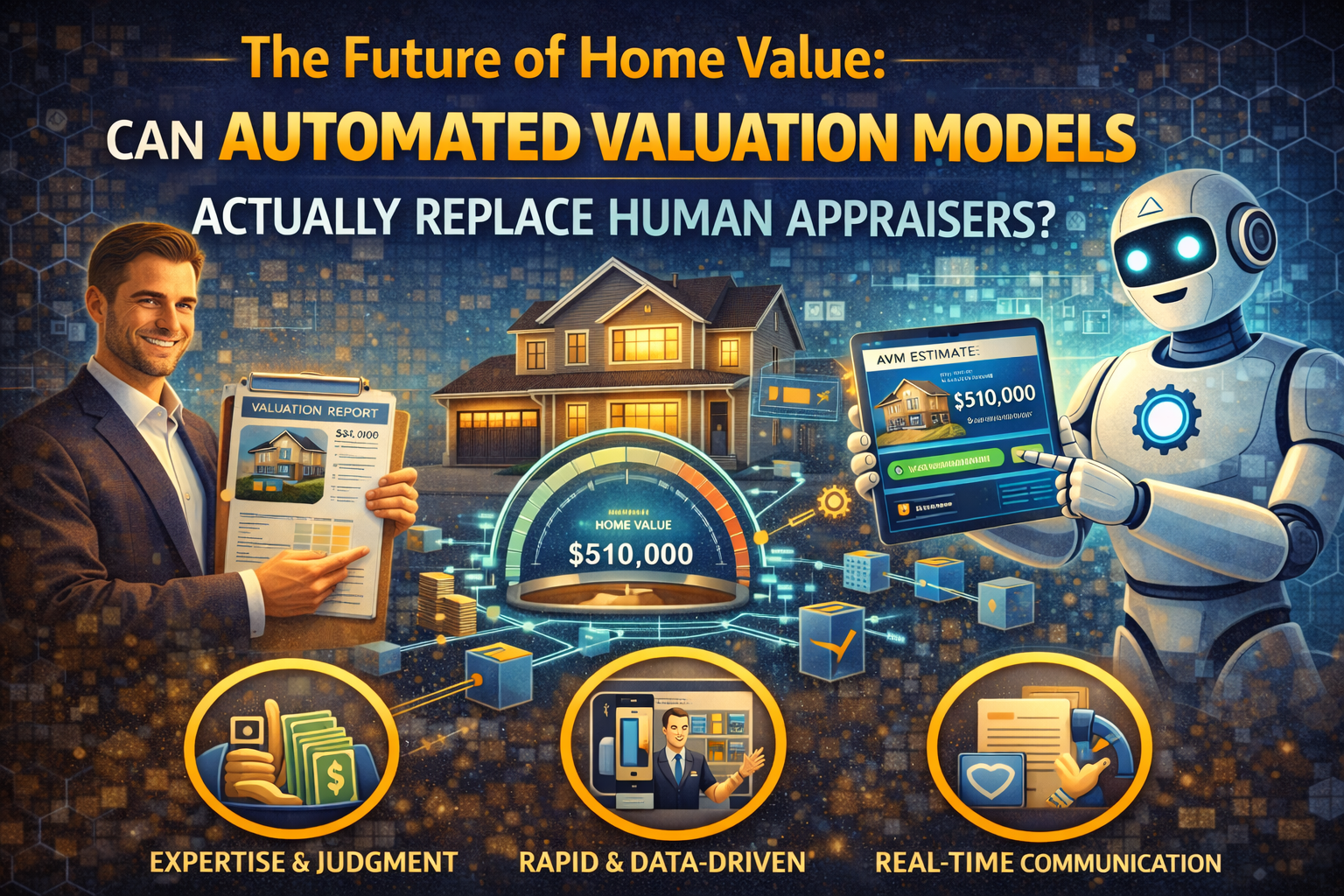
Discover the pros and cons of Automated Valuation Models in real estate. Can software really replace the local expertise of a professional human appraiser?
Table of Contents
I’ll never forget the look on a client’s face last summer when her “Zestimate” dropped by $40,000 the day before we hit the market. She was panicked, clutching her laptop like it was a crystal ball. “The computer says my house is worth less,” she lamented. I had to walk her through the reality that the software hadn’t seen her brand-new Italian marble countertops or the custom primary suite she’d spent six months perfecting.
This is the central tension in our industry today. We are increasingly leaning on Automated Valuation Models to tell us what a piece of dirt and a pile of bricks are worth. On the surface, it’s a dream for lenders and high-volume investors. It’s fast, it’s cheap, and it doesn’t involve scheduling a physical walkthrough.
But as someone who has spent years navigating local market trends and quirky neighborhoods, I’ve seen where the math fails. Automated Valuation Models are powerful tools, but they lack a “nose” for the business. They don’t know that the house three doors down sold for a premium because it had a secret view of the canyon, or that a specific cul-de-sac is the most coveted block in the zip code. We are entering a phase where tech is clashing with boots-on-the-ground intuition, and the winner isn’t as obvious as you might think.
What Exactly Are Automated Valuation Models?
For the uninitiated, Automated Valuation Models (or AVMs) are essentially complex mathematical algorithms. They pull data from public records, tax assessments, and recent sales on the Multiple Listing Service (MLS) to calculate a property’s market value in seconds.
Banks love them because they can process thousands of home equity lines of credit (HELOCs) without waiting for a human to drive out to every suburban driveway. In a world that demands instant gratification, Automated Valuation Models provide a “good enough” estimate that keeps the gears of finance turning. However, “good enough” is a dangerous phrase when you are talking about your life’s largest financial investment.
The Blind Spots of the Algorithm
The biggest problem with Automated Valuation Models is that they are only as good as the data they ingest. If the public record says your home is a 3-bedroom, 2-bathroom ranch, but you converted the garage into a legal ADU (Accessory Dwelling Unit) last year, the algorithm is likely going to miss that added value.
Software cannot smell a musty basement or see the subtle cracks in a foundation that suggest a looming drainage issue. These are things a professional human appraiser picks up the moment they step onto the porch. While Automated Valuation Models are getting better at using satellite imagery and computer vision to analyze curb appeal, they still struggle with the “subjective” quality of a home.
- Interior Condition: The difference between “original 1970s” and “fully renovated” is massive in terms of sale price, yet often invisible to a basic data feed.
- Hyper-Local Nuance: A house on the “wrong” side of a busy arterial road can be worth 15% less than one just 50 yards away. Automated Valuation Models often smooth over these sharp edges.
- Unique Features: How do you put a price on a hand-carved staircase or a professional-grade recording studio in the basement? Software tends to average these outliers away.
According to the National Association of Realtors (NAR), buyers and sellers still rank “help with determining the right price” as one of the top reasons they hire a professional. They realize that while Automated Valuation Models give them a starting point, the final number requires a human touch.
Why Lenders are Pushing for More Automation
Despite the flaws, the momentum behind Automated Valuation Models is growing, especially in the secondary mortgage market. Speed is a competitive advantage. If a lender can close a loan in seven days because they skipped the traditional appraisal process, they are going to win the deal.
We are seeing a rise in “Desktop Appraisals” and “Hybrid Appraisals.” In these scenarios, a third party might take photos of the house, but the final value is determined by Automated Valuation Models checked by a remote human. It’s a middle-ground approach that tries to combine the efficiency of software with a tiny bit of human oversight.
For a deeper look at the statistical foundations of these programs, Wikipedia’s entry on Automated Valuation Models offers an excellent breakdown of the hedonic regression and index-based methods used by the big players. It’s a fascinating look at how the industry is trying to turn the “art” of home valuation into a pure science.
The Human Appraiser’s Secret Weapon: The “Comp” Adjustment
In a traditional appraisal, the professional looks at “comps” (comparable sales). But they don’t just look at the raw numbers. They make manual adjustments. If Comp A has a pool and your house doesn’t, they subtract the value of that pool. If Comp B is located near a noisy airport and your house is in a quiet park-like setting, they add value.
This level of granular detail is where Automated Valuation Models often stumble. The algorithm might see two houses with the same square footage and assume they are identical. A human knows that one has a view of the dumpsters behind a grocery store, while the other looks at a rolling meadow. In high-stakes luxury real estate or complex commercial deals, relying solely on Automated Valuation Models is a recipe for a massive financial error.
The Hybrid Future: Humans + Machines
I don’t think we are headed toward a world where human appraisers are completely extinct. Instead, I think we are moving toward a partnership. The most successful professionals are already using Automated Valuation Models to do the “grunt work” of gathering data, which frees them up to focus on the high-level analysis that only a human can provide.
Think of it like a pilot in a modern jet. The autopilot does most of the flying during the steady parts of the trip, but you definitely want a human in the seat during a stormy landing. Real estate is full of “stormy landings.” Whether it’s an estate sale with complex legal issues or a custom-built home that defies categorization, Automated Valuation Models are simply not equipped to handle the complexity of real human lives.
As noted by the Appraisal Institute, the professional standards for valuation are evolving to incorporate new technology, but the core requirement for “independence and impartiality” remains a human-centric trait. A machine can be programmed, but a human can be held ethically accountable.
The Role of Big Data in Pricing
We have to admit that Automated Valuation Models have brought a level of transparency to the market that didn’t exist twenty years ago. Before the internet, home values were a closely guarded secret held by brokers and tax offices. Now, every buyer enters the market with a “price range” already in mind, thanks to the accessibility of these algorithms.
This democratized data has made the market more efficient. Sellers are less likely to overprice their homes by 50%, and buyers are less likely to be “taken for a ride.” In this sense, Automated Valuation Models have been a net positive for the consumer, even if they occasionally get the individual numbers wrong.
FAQ Section
How accurate are Automated Valuation Models? Accuracy varies significantly by location. In a cookie-cutter suburban neighborhood where every house is similar, Automated Valuation Models can be within 2-3% of the sale price. In rural areas or historic districts with unique homes, the margin of error can be 10% or higher.
Can I use an AVM for my mortgage? It depends on the lender and the type of loan. For many refinances or HELOCs, banks are comfortable using Automated Valuation Models. However, for a standard home purchase, most lenders still require a full interior inspection and appraisal by a licensed human professional.
Why did my Zestimate or Redfin Estimate change so suddenly? These Automated Valuation Models react to new data instantly. If a house on your street sold for a surprisingly low price (perhaps a “fire sale” between family members), the algorithm might assume the whole neighborhood has dropped in value, even if that isn’t true.
How can I “fix” an incorrect value on an AVM? Most platforms allow homeowners to claim their home and update the facts. You can correct the square footage, mention a finished basement, or update the number of bathrooms. This “cleaner” data helps the Automated Valuation Models provide a more accurate estimate over time.
Are Automated Valuation Models biased? There is an ongoing debate about this in the industry. Because Automated Valuation Models rely on historical data, some argue they can inadvertently bake in old biases from previous decades of lending. This is another reason why human oversight remains a critical part of the valuation process.
Conclusion
At the end of the day, a house is worth what a willing buyer is willing to pay and a willing seller is willing to accept. No matter how many millions of data points Automated Valuation Models analyze, they cannot predict the human heart. They can’t account for the “vibe” of a neighborhood or the emotional pull of a perfectly placed bay window.
Technology is wonderful for the “what” and the “where,” but it still struggles with the “why.” We will continue to see Automated Valuation Models handle the bulk of the high-volume, low-risk work in the lending world. But for the big moves—the family homes, the unique investments, and the high-ticket deals—the human appraiser isn’t going anywhere. You can’t code for 20 years of local experience.
