
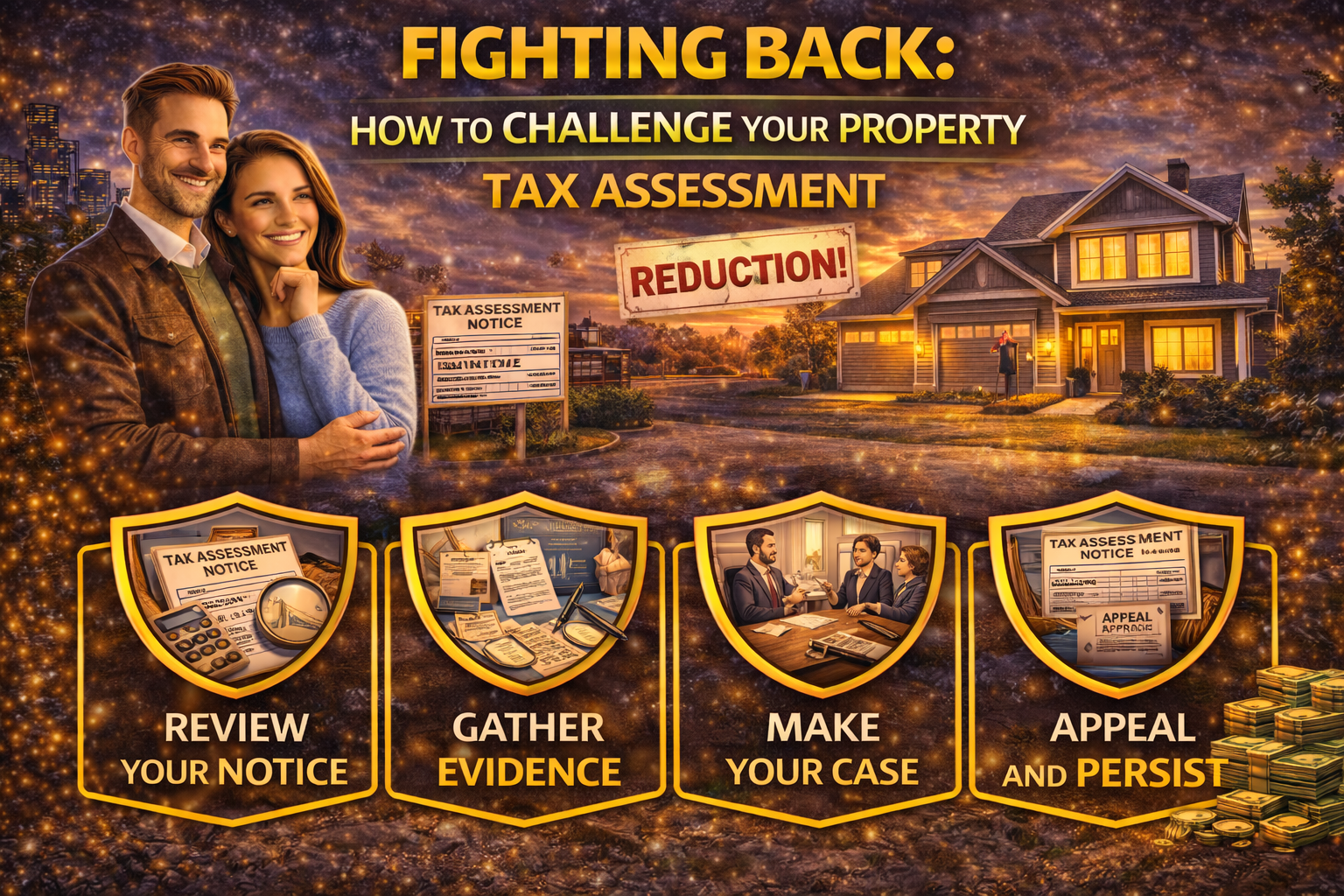
Is your tax bill too high? Learn the exact steps to challenge your Property Tax Assessment, find errors in your records, and lower your annual tax bill.
Table of Contents
I remember the first time I opened my mail and saw a double-digit jump in my annual tax bill. My stomach did a little somersault. I hadn’t renovated the kitchen, I hadn’t added a pool, and the neighborhood hadn’t suddenly turned into Beverly Hills. It felt like the county was just reaching into my wallet because they could.
Most homeowners simply grumble, write the check, and move on. They assume the government’s math is flawless. But after years in the real estate industry, I’ve learned a secret: the people behind your Property Tax Assessment are human, and they are often working with outdated or generalized data.
Challenging your valuation isn’t about being litigious; it’s about ensuring you aren’t paying more than your fair share. If your Property Tax Assessment is based on an incorrect square footage or a “market value” that doesn’t account for the cracked foundation you’ve been ignoring, you have every right to appeal. Let’s walk through how to build a case that the assessor can’t ignore.
Step 1: Understand the Timeline and the Terms
The most common reason people fail at lowering their taxes isn’t because they don’t have a case—it’s because they missed the deadline. Every municipality has a specific window, often just 30 to 60 days after you receive your notice, to file an appeal.
You need to look closely at your Property Tax Assessment card. It will list two important numbers: the market value (what they think the home is worth) and the assessed value (the portion of that value that is actually taxed).
In many areas, these numbers are adjusted by an “equalization rate.” If your county assesses at 100% of market value, and they say your home is worth $500,000 when similar homes are selling for $420,000, your Property Tax Assessment is officially out of whack.
Step 2: Scrutinize Your Property Record Card
Before you start arguing about market trends, go to the assessor’s office or their website and request your official property record card. This is the “cheat sheet” the county uses for your Property Tax Assessment.
I’ve seen cards that claim a finished basement when it’s actually a crawlspace. I’ve seen three-bedroom homes listed as five-bedroom homes. If there is a factual error on this card—like the wrong lot size or an incorrect number of bathrooms—correcting it is often the easiest way to win your appeal.
According to the National Association of Realtors (NAR), many local governments rely on “mass appraisal” techniques. This means they use an algorithm to value your home based on the general area, often ignoring the specific quirks and flaws of your individual property.
Step 3: Finding Your Comparables (The “Comps”)
This is where you put on your real estate agent hat. To win a challenge against your Property Tax Assessment, you need evidence. You need to find 3 to 5 properties that are truly similar to yours that sold recently.
Look for homes in your specific sub-neighborhood with:
- Similar square footage (within 10%).
- The same number of bedrooms and bathrooms.
- Similar age and architectural style.
If your Property Tax Assessment is $450,000, but three identical houses on your street sold for $400,000 last month, you have a rock-solid case. You can find this sales data on sites like Zillow or by asking a local Realtor for a Comparative Market Analysis (CMA). For more on how these valuations are calculated legally, Wikipedia’s entry on Property Tax offers a great deep dive into the different assessment cycles used across the country.
Step 4: Highlight the Flaws (The “Ugly” Tour)
Assessors love a fresh coat of paint and a manicured lawn. When they do a “drive-by” Property Tax Assessment, they see the curb appeal. They don’t see the 20-year-old furnace, the water damage in the attic, or the fact that your kitchen hasn’t been updated since 1984.
To lower your Property Tax Assessment, you need to highlight the negative features that decrease your home’s value.
- Take Photos: Document every crack, leak, and outdated fixture.
- Get Estimates: If your roof needs $15,000 in repairs, get a written quote from a contractor.
- Internal Issues: If your home has a poor layout (like a “walk-through” bedroom), point it out. These “functional obsolescence” issues are often ignored in a mass Property Tax Assessment.
Step 5: The Informal Meeting
In many counties, you don’t have to go straight to a formal board hearing. You can often request an informal meeting with the assessor. This is your chance to be a reasonable neighbor, not a hostile taxpayer.
Walk in with your property record card, your photos of repairs needed, and your list of comparable sales. Sometimes, the assessor will see the logic and adjust your Property Tax Assessment on the spot just to avoid the paperwork of a formal grievance. Be polite but firm. Your goal is to show them that their data doesn’t match the reality of your front door.
Step 6: Presenting at the Board of Review
If the informal meeting doesn’t work, you’ll head to the Board of Review. This is a formal panel, but it’s not as scary as a courtroom. You’ll have a few minutes to present your case.
Don’t talk about how high your taxes are compared to your cousin in the next state. The board doesn’t care about the tax rate; they only care about the valuation. Stick to the facts: “The Property Tax Assessment says my home is worth $500k, but here are three sales at $450k and a contractor’s estimate for $20k in foundation repairs.”
Keep your presentation organized. Bring copies of your evidence for everyone on the board. When you treat the process like a business presentation, you are much more likely to see a reduction in your Property Tax Assessment.
Step 7: Check for Exemptions
Sometimes the easiest way to “win” isn’t by lowering the valuation, but by ensuring you are getting every discount you’re entitled to. Many homeowners miss out on exemptions that would drastically change the outcome of their Property Tax Assessment.
- Homestead Exemption: For your primary residence.
- Senior Citizen Exemption: Usually based on age and income.
- Veterans Exemption: For those who served.
- Agricultural or Greenbelt: For larger plots of land.
Check your local tax office website for a full list. If you qualify for an exemption that wasn’t applied, your Property Tax Assessment might stay the same, but your actual bill will drop significantly.
FAQ Section
How much does it cost to appeal a property tax assessment? In many jurisdictions, filing an appeal is free or carries a very small administrative fee (usually under $50). If you hire a professional appraiser or an attorney, you’ll pay for their time, but many homeowners successfully win on their own using the steps above.
Will the assessor come inside my house if I appeal? They might ask to. You generally have the right to refuse, but if you are claiming the interior is in poor condition to lower your Property Tax Assessment, it might be in your best interest to let them see the “ugly” parts you’ve documented.
Can my property tax assessment actually go up if I appeal? Technically, yes, but it is extremely rare. If the assessor discovers you’ve added an unpermitted deck or a finished basement that wasn’t on the records, they could increase the value. However, most people only appeal when the valuation is clearly inflated compared to the market.
What are the most common errors found on property record cards? The most common mistakes include incorrect square footage, the wrong number of bathrooms, listing a fireplace that doesn’t exist, or incorrectly classifying a finished basement as a “full living floor.” Each of these can significantly inflate your Property Tax Assessment.
Does a lower tax assessment hurt my resale value? Not really. Buyers know that a Property Tax Assessment is for tax purposes and often lags behind real-world market value. In fact, a lower tax bill can be a selling point for a buyer who is looking at their total monthly “PITI” (Principal, Interest, Taxes, Insurance) payment.
Conclusion
At the end of the day, you are the world’s leading expert on your own home. You know every squeaky floorboard and every drafty window. While the county sees your house as a data point on a map, you see the reality of its condition.
By taking the time to review your property record card and gathering solid market evidence, you can successfully challenge an unfair Property Tax Assessment. It’s a bit of homework, but for a saving of several hundred (or even thousand) dollars a year, it’s a project that pays for itself many times over. Don’t let a clerical error or a faulty algorithm dictate your housing costs—take a look at your latest notice and see if the numbers truly add up.
