
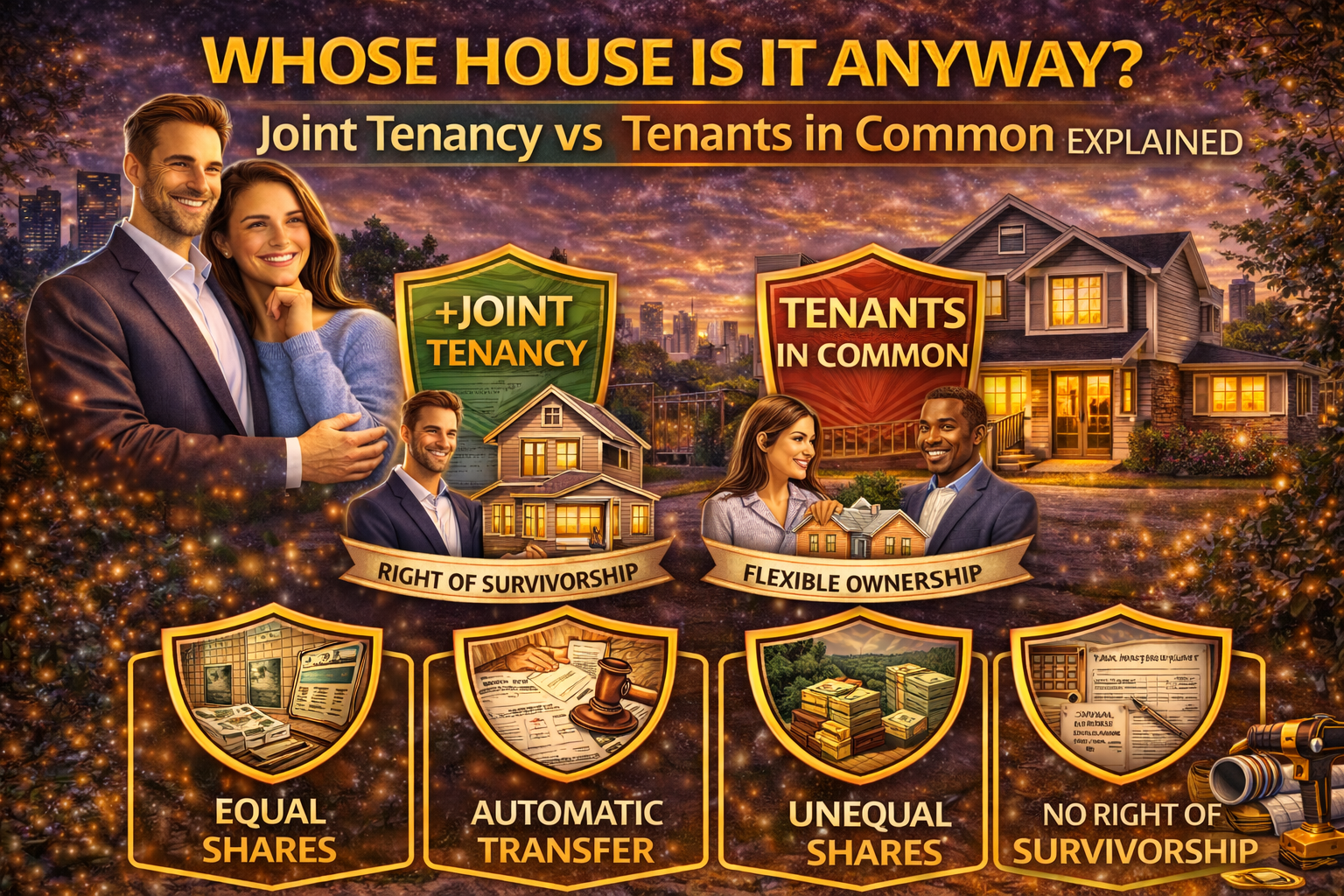
Buying property with someone else? Understand the critical differences in Joint Tenancy vs Tenants in Common regarding ownership, inheritance, and your rights.
Table of Contents
I’ll never forget a closing I attended a few years ago for a young couple and the husband’s brother. They were all pitching in to buy a beautiful triplex in a gentrifying part of town. They were excited, high-fiving in the hallway of the title company, and dreaming about rental income. But when the escrow officer asked, “How would you like to take title?”, the room went dead silent.
They looked at each other, then at me, then back at the paperwork. They hadn’t realized that the “how” of owning a home is just as important as the “what.” In the world of real estate, choosing between Joint Tenancy vs Tenants in Common isn’t just a legal formality; it’s a decision that dictates who gets the house if you die and how much of the property you actually “own” on paper.
If you are buying a home with a spouse, a business partner, or a group of friends, you need to understand the mechanics of these two structures. One offers a seamless transition of ownership, while the other provides a flexible, modular way to divide equity. Let’s break down the debate of Joint Tenancy vs Tenants in Common so you don’t find yourself speechless at the closing table.
The Basics of Joint Tenancy: The “All for One” Model
Most married couples default to this option without even thinking about it. In a joint tenancy, everyone on the deed owns an equal, undivided interest in the entire property. You don’t own the “left half” while your partner owns the “right half.” You both own 100% of the whole thing together.
The defining characteristic of this model is the Right of Survivorship. This is a powerful legal mechanism. If one owner passes away, their share doesn’t go to their kids or through a complex probate process; it automatically and instantly transfers to the surviving owner. This makes it a popular choice for those who want to ensure their partner is taken care of without a massive legal bill.
However, when comparing Joint Tenancy vs Tenants in Common, the lack of flexibility is the main drawback here. To create a joint tenancy, you must satisfy the “four unities”: you must all take title at the same time, through the same deed, with equal interest, and with equal rights to possess the property. It is a rigid, all-encompassing way to hold title.
Tenants in Common: The Modular Approach
Now, imagine you are buying an investment property with two friends. You are putting up 50% of the cash, while they are each putting up 25%. In this scenario, the equal-split nature of a joint tenancy feels unfair. This is where the Joint Tenancy vs Tenants in Common choice leans heavily toward the latter.
Under a tenancy in common, ownership can be divided in any way you choose. You can own 70% while your partner owns 30%. You can also take title at different times. If a new investor wants to buy into your commercial building three years after you started, you can simply add them to the deed as a tenant in common.
The most significant difference in Joint Tenancy vs Tenants in Common is what happens when someone dies. There is no right of survivorship here. If you own 40% of a house as a tenant in common and you pass away, that 40% goes to whoever is named in your will. This is a vital distinction for business partners or people in second marriages who want their equity to go to their children rather than their co-owner.
Ownership Rights and Financial Responsibility
Regardless of which side you land on in the Joint Tenancy vs Tenants in Common debate, your basic rights to the property are fairly similar. Every co-owner has a right to occupy the entire property. You can’t tell your 10% co-owner that they are restricted to the basement.
Financially, things get a bit more intertwined. Lenders usually require all co-owners to sign the mortgage. This means that if one person stops paying, the bank doesn’t care about your “equal share”—they will come after the whole property. According to the National Association of Realtors (NAR), understanding your liability is crucial before signing a deed with anyone, regardless of the ownership structure.
Breaking Up: How to Exit the Agreement
What happens when the honeymoon phase ends or a business partnership sours? In a Joint Tenancy vs Tenants in Common setup, exiting isn’t always easy.
In a tenancy in common, you can generally sell or mortgage your specific share without the permission of the other owners. In a joint tenancy, selling your share “breaks” the tenancy. If you sell your interest to a stranger, the joint tenancy is dissolved, and the new relationship between the remaining owners and the stranger becomes a tenancy in common.
If everyone is fighting and nobody can agree on whether to sell, you might find yourself in a “Partition Action.” This is a legal proceeding where a judge orders the sale of the property so the proceeds can be divided. It is expensive, messy, and the ultimate reason why you should have a co-ownership agreement drafted by a lawyer before you buy.
For more on the historical legalities and variations like “Tenancy by the Entirety,” Wikipedia’s entry on Concurrent Estate provides a great deep dive into how these laws evolved from English common law to modern property codes. It’s a fascinating look at why the Joint Tenancy vs Tenants in Common distinction is so deeply rooted in our legal system.
Tax Implications and Estate Planning
Your choice of Joint Tenancy vs Tenants in Common will have a massive ripple effect on your estate taxes. Because joint tenancy bypasses probate, it can be a fast way to transfer assets. However, it can also create “gift tax” issues if you add someone to a deed who didn’t contribute financially.
In a tenancy in common, the value of your specific share is included in your taxable estate. This allows for more granular tax planning, especially for high-net-worth individuals or those with complex family structures. Most estate planners will tell you that the Joint Tenancy vs Tenants in Common decision is the foundation upon which your entire legacy is built.
Which One Is Right for You?
So, how do you decide? Generally, if you are a married couple or a long-term committed pair who wants a seamless transfer of the home to the survivor, the “survivorship” aspect makes the Joint Tenancy vs Tenants in Common choice easy: go with joint tenancy.
If you are business partners, siblings inheriting a family cottage, or friends buying a “hackable” duplex, you almost always want a tenancy in common. It protects your individual heirs and allows you to reflect the actual financial contributions each person made.
I’ve seen too many families torn apart because they chose the wrong title structure. They assumed the law would just “figure it out” when someone died. Trust me, the law will figure it out, but it might not be the version of “fair” you had in mind. In the battle of Joint Tenancy vs Tenants in Common, clarity is your best friend.
FAQ Section
Does Joint Tenancy vs Tenants in Common affect the mortgage? Not usually. Most lenders will hold all owners “jointly and severally” liable for the debt. This means the bank expects the full payment every month, regardless of how you’ve divided the ownership percentages on the deed.
Can a Joint Tenancy be changed to a Tenancy in Common later? Yes. An owner can “sever” the joint tenancy by conveying their interest to themselves or someone else. This effectively turns the ownership structure into a tenancy in common and removes the right of survivorship.
What is the “Right of Survivorship”? This is the “magic trick” of joint tenancy. It ensures that when one owner dies, their interest in the property vanishes and is instantly absorbed by the surviving owners. It completely bypasses the will and the probate court.
Do all owners have to agree to sell the house? In a practical sense, yes. A buyer is unlikely to purchase a “50% share” of a house if they can’t get the other owner to sell. If owners can’t agree, they must go to court for a partition sale to force a liquidation of the asset.
Is one better for avoiding taxes? Neither is a “tax shelter,” but they handle inheritance differently. Joint tenancy avoids the cost and delay of probate, while tenancy in common allows you to direct your equity to specific heirs, which might be better for complex estate tax strategies.
Conclusion
At the end of the day, buying a home is a huge emotional and financial milestone. It’s easy to get caught up in the kitchen finishes and the neighborhood vibes, but the boring legal stuff—like choosing Joint Tenancy vs Tenants in Common—is what protects your future.
Take the time to talk to a real estate attorney or a qualified title officer before you sign that final deed. Make sure your ownership structure matches your actual intent for the property. When you get the Joint Tenancy vs Tenants in Common part right, you can enjoy your new home knowing your rights, and your family’s future, are completely secure.
