
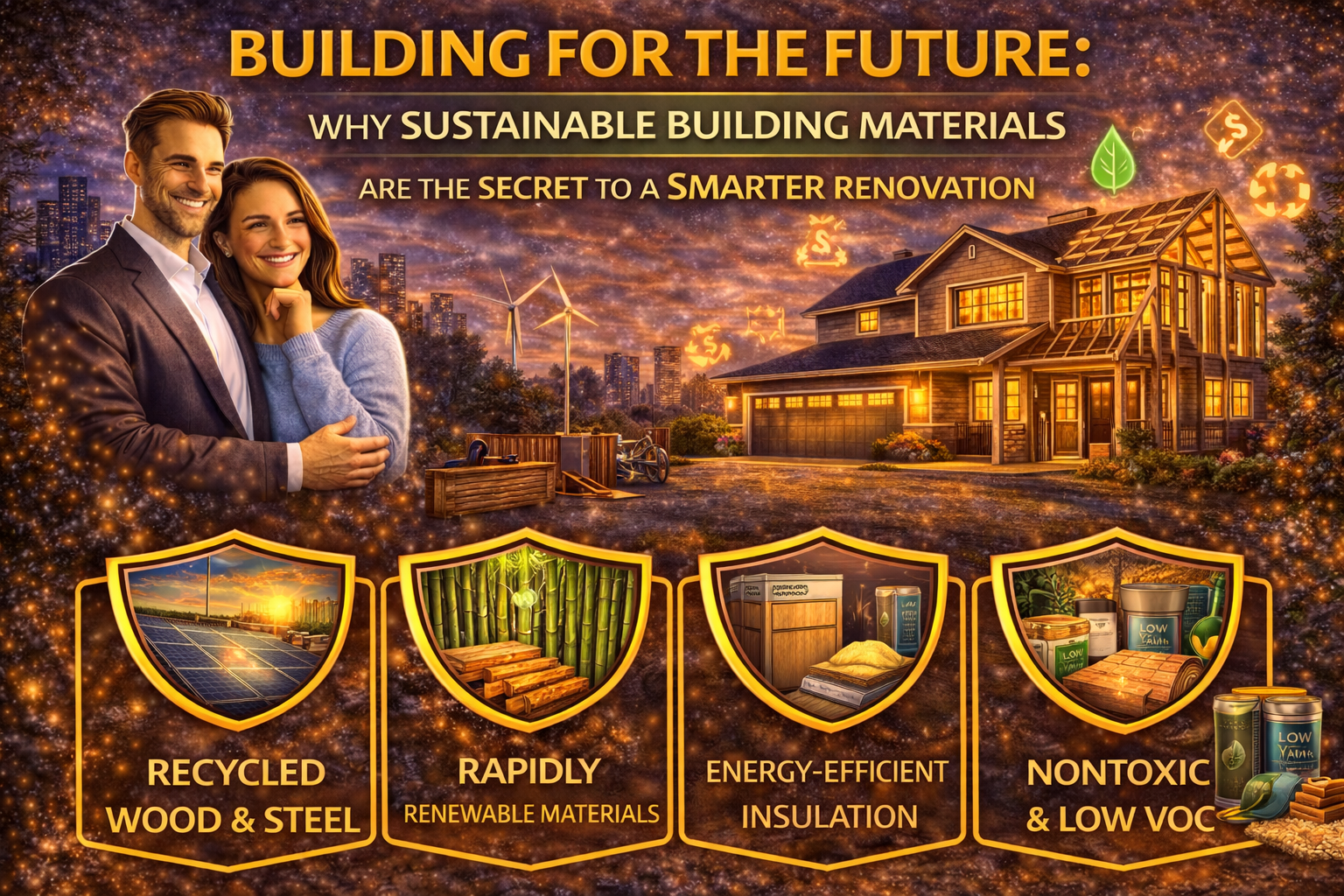
Planning a home remodel? Discover how using Sustainable Building Materials can boost your property value, lower energy costs, and create a healthier home.
Table of Contents
I’ll never forget a walkthrough I did last year with a couple looking at a mid-century fixer-upper. We were standing in a kitchen that hadn’t been touched since 1974, and the smell of old adhesive and off-gassing particleboard was almost overwhelming. The husband looked at me and said, “I want this to be a beautiful house, but I don’t want it to be a toxic one.”
That conversation stayed with me because it perfectly captures the shift we are seeing across the entire real estate market. People are tired of the “fast furniture” equivalent of housing—cheap materials that look okay for two years but break down quickly and leach chemicals into the air.
If you are planning a remodel in 2026, you have a massive opportunity. Choosing Sustainable Building Materials isn’t just about “saving the planet” in an abstract sense; it’s about choosing products that are more durable, more efficient, and ultimately more valuable. Whether you are an investor looking to future-proof a rental or a homeowner creating a legacy, the choices you make during the demolition and construction phase will dictate your cost of ownership for decades.
The Financial Case for Green Remodeling
Most homeowners I talk to have the same initial fear: “Isn’t going green going to blow my budget?” It is a fair question. Traditionally, there was a significant “green premium” on eco-friendly products.
However, as demand has skyrocketed, the price gap has narrowed significantly. In many cases, Sustainable Building Materials offer a much better ROI when you consider the lifespan of the product. Take reclaimed wood flooring, for example. While it might cost more upfront than cheap laminate, it can be sanded and refinished for a century, adding a timeless character that standard materials simply cannot match.
Furthermore, the real estate market is increasingly rewarding these choices. Homes featuring certified Sustainable Building Materials and high-efficiency upgrades are consistently selling faster than their conventional counterparts. Buyers are getting smarter; they are looking past the granite countertops and asking about the R-value of the insulation and the VOC levels of the paint.
Reclaimed and Recycled: Giving Materials a Second Life
One of the most effective ways to lower the carbon footprint of your renovation is to use what already exists. Reclaimed timber, salvaged bricks, and recycled metal are cornerstones of high-end, eco-conscious design.
Using Sustainable Building Materials that have been diverted from a landfill adds an immediate layer of “soul” to a renovation. I recently saw a master suite where the accent wall was made from snow fencing salvaged from the Wyoming plains. It wasn’t just a wall; it was a conversation piece.
According to the National Association of Realtors (NAR), sustainability is becoming a key factor in home buying decisions for Millennials and Gen Z. By incorporating Sustainable Building Materials like recycled glass countertops or reclaimed beams, you are speaking directly to the largest demographic of homebuyers in history.
High-Performance Insulation and the “Airtight” Goal
If you are opening up your walls, the most important decision you will make isn’t the color of the tile; it’s what you put inside the studs. Traditional fiberglass batts are “fine,” but they aren’t great.
Modern Sustainable Building Materials for insulation, such as sheep’s wool, hempcrete, or cellulose made from recycled newspapers, offer superior thermal performance without the irritating fibers. These materials breathe better, manage moisture more effectively, and provide a much quieter indoor environment.
When you prioritize Sustainable Building Materials in your home’s envelope, you are essentially “right-sizing” your future utility bills. For a deeper dive into how these materials are classified and tested, Wikipedia’s entry on Green Building offers a fantastic overview of international standards like LEED and Passive House.
Bamboo and Cork: The Fast-Growing Superstars
If you are looking for new flooring, you have to look at bamboo and cork. Both are considered premier Sustainable Building Materials because they are rapidly renewable.
Bamboo can reach maturity in just three to five years, compared to decades for a traditional oak or maple tree. It is incredibly hard, durable, and handles moisture better than many hardwoods. Cork, on the other hand, is harvested from the bark of the tree, meaning the tree stays alive and continues to absorb carbon for centuries.
As a real estate blogger, I’ve seen cork used in high-end condos to provide incredible sound insulation between floors. It’s naturally antimicrobial and feels warm underfoot—perfect for kitchens where you spend a lot of time standing. Choosing Sustainable Building Materials like these proves that you don’t have to sacrifice comfort for ethics.
The Health Benefit: Low-VOC and Natural Finishes
The “new house smell” we all know is actually the smell of volatile organic compounds (VOCs) off-gassing into your lungs. In a standard renovation, the paints, glues, and carpets can release these chemicals for years.
By insisting on Sustainable Building Materials such as low-VOC paints, natural clay plasters, and formaldehyde-free cabinetry, you are creating a healthier environment for your family. This is a massive selling point in the luxury rental market. Parents are willing to pay a premium for a “healthy home” where they don’t have to worry about the air quality their toddlers are breathing.
Exterior Solutions: Living Roofs and Smart Siding
Don’t forget the outside of the house! Your choice of Sustainable Building Materials for the exterior can impact your neighborhood’s microclimate and your home’s durability.
- Metal Roofing: Highly recyclable and excellent for reflecting solar heat.
- Fiber Cement Siding: Durable, fire-resistant, and made from sustainable sand and cellulose fibers.
- Permeable Pavers: These allow rainwater to soak into the ground rather than running off into the sewer system.
Integrating Sustainable Building Materials into your landscaping and roofing helps mitigate the “heat island” effect in urban areas. It also reduces the maintenance burden, as these products are designed to withstand the increasingly volatile weather patterns we are seeing across the country.
Smart Technology: The Digital Partner for Sustainability
While not a “material” in the traditional sense, smart home technology is the essential partner for Sustainable Building Materials. A house built with high-performance hemp insulation is great, but a house that also knows when to dim the lights and lower the shades to prevent solar heat gain is even better.
When you market a home, showing the synergy between Sustainable Building Materials and smart thermostats or energy-monitoring systems creates a powerful narrative of “modern efficiency.” It tells the buyer that the home is thinking for them, saving them money while they sleep.
For those interested in the environmental impact of their choices, the Environmental Protection Agency (EPA) provides rigorous guidelines on how to evaluate the lifecycle of different products. It’s a great way to verify that your Sustainable Building Materials are actually as “green” as the marketing suggests.
FAQ Section
Are sustainable building materials more expensive? While some products carry a 10-20% higher upfront cost, many Sustainable Building Materials save money over time through lower maintenance costs and reduced energy bills. Additionally, the gap is closing as these materials become more mainstream.
Will using sustainable materials increase my home’s resale value? Yes. In many competitive markets, “green” features are a major differentiator. Buyers value lower operating costs and healthier indoor air quality, which can lead to faster sales and higher offer prices.
What is the easiest sustainable material to start with? Paint is the simplest entry point. Switching to zero-VOC or low-VOC paint is an inexpensive way to immediately improve indoor air quality during a renovation without requiring a major structural change.
How can I tell if a material is truly sustainable? Look for third-party certifications like Forest Stewardship Council (FSC) for wood, Cradle to Cradle for manufacturing, or GreenGuard for air quality. Don’t just trust “eco-friendly” labels on the box.
Can I use sustainable building materials in a historic renovation? Absolutely. In fact, many Sustainable Building Materials, like lime plaster and reclaimed wood, are more historically accurate than modern synthetic alternatives. It’s a great way to preserve a home’s character while improving its performance.
Conclusion
At the end of the day, a renovation is a chance to reset. It is your opportunity to take a building and make it better, not just for the next few years, but for the next generation.
Choosing Sustainable Building Materials is a vote for quality. It is an investment in a home that breathes better, lasts longer, and costs less to run. Whether you are doing a full “to-the-studs” remodel or just updating a bathroom, make the choice to use products that respect the future of the planet and the health of the people living inside. Your home is your most significant asset—build it with materials that are as resilient as you are.
