
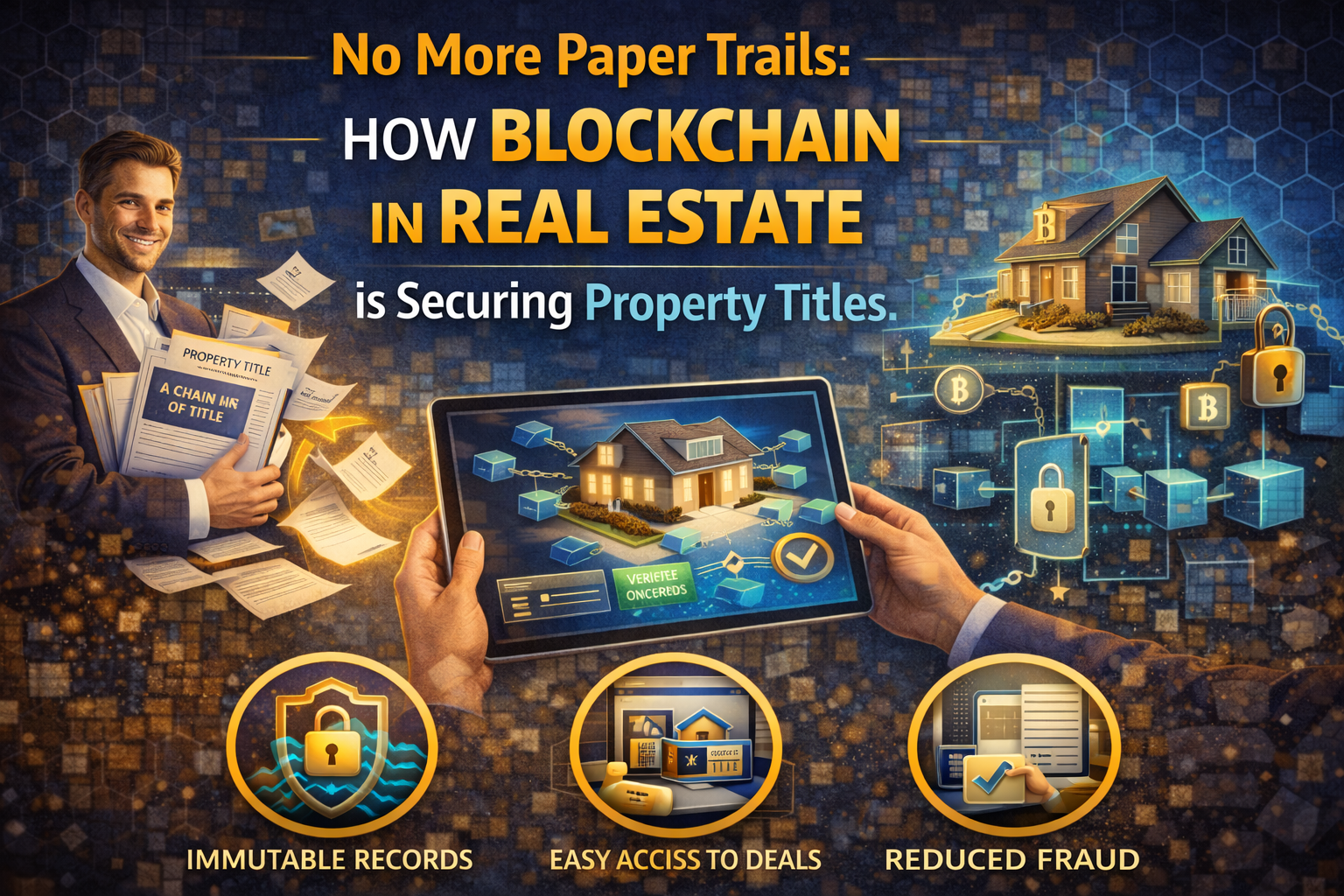
Tired of title fraud and endless paperwork? Discover how Blockchain in Real Estate is revolutionizing property ownership and securing digital titles.
Table of Contents
I’ll never forget the sheer volume of paper that hit the desk during my first house closing. It was a mountain. There were deeds, affidavits, title insurance binders, and mortgage notes—half of which felt like they were written in a language from the 18th century. As I sat there signing my name for the fortieth time, I kept thinking: “It is 2026. Why am I still relying on a physical folder and a notary’s rubber stamp to prove I own this dirt?”
The traditional system of recording property titles is, frankly, a mess. In many counties, we are still relying on centralized databases that can be hacked, or worse, physical ledgers that can be lost in a fire. Title fraud is a billion-dollar headache, and the “title search” process is a slow, expensive bottleneck that adds thousands to your closing costs.
But things are finally shifting. The integration of Blockchain in Real Estate is moving us away from dusty filing cabinets and toward an immutable, digital ledger. By creating a decentralized record of ownership, we are making it nearly impossible for scammers to sell a house they don’t own. It isn’t just a tech trend; it’s a fundamental upgrade to how we define “who owns what.”
The Problem with the Current Title System
If you buy a car, you get a title from the DMV. If someone steals that piece of paper, they still have a hard time proving they own the car because the VIN is tied to your name in a database. In property, things are murkier. Deeds can be forged, and liens can be hidden behind layers of bureaucratic red tape.
The current system relies on “Title Insurance” to protect you from these errors. You basically pay a premium to protect yourself against the possibility that the county’s records are wrong. It is a reactive solution to a broken system. When we implement Blockchain in Real Estate, we move to a proactive system.
Because a blockchain is a distributed ledger, every transaction is verified by a network of computers. Once a property transfer is recorded, it is “hashed” and locked in place. You cannot go back and retroactively change who owned the house in 1995 to pull off a scam. The history is permanent, transparent, and unhackable.
How Blockchain in Real Estate Prevents Title Fraud
Title fraud usually happens when a criminal forges a deed and records it at the county office, then takes out a massive home equity line of credit (HELOC) and disappears with the cash. The homeowner doesn’t even know it happened until they get a foreclosure notice.
With Blockchain in Real Estate, the “private key” to the property title stays with the owner. To transfer the title, the owner must digitally sign the transaction. Without that digital signature, no forged paper deed in the world will move the ownership record on the chain.
- Instant Verification: No need for a 10-day title search.
- Encryption: Your ownership data is secured by advanced cryptography.
- Decentralization: No single point of failure; the record exists on thousands of nodes.
According to the National Association of Realtors (NAR), this technology is one of the most significant advancements for the industry since the invention of the digital MLS. It removes the friction that makes real estate transactions so stressful and expensive for the average buyer.
Smart Contracts: The End of Escrow as We Know It?
One of the most exciting applications of Blockchain in Real Estate is the “Smart Contract.” In a typical deal, you have an escrow officer who sits in the middle, holding the buyer’s money and the seller’s deed until all conditions are met. It is a slow, manual process that relies on human trust.
A smart contract is essentially a “if/then” program. If the buyer’s funds are verified and the inspection contingencies are cleared, then the title is automatically transferred to the buyer and the funds are released to the seller. No middleman, no waiting for wire transfers, and no chance for one party to “forget” a signature.
This automation doesn’t just save time; it saves money. By removing the administrative heavy lifting, we can significantly lower the closing costs for families. For a deeper look at the technical architecture behind these ledgers, Wikipedia’s entry on Blockchain provides an excellent foundation for understanding how blocks are linked and secured.
Real-World Examples: From Surry County to Sweden
This isn’t just a theoretical concept. Several counties in the United States, including Surry County in North Carolina, have already begun pilot programs to record land records using Blockchain in Real Estate. They are finding that it drastically reduces the time it takes to process a deed.
Internationally, countries like Sweden and Georgia have been pioneers in this space. They realized that by moving their national land registries to a blockchain-based system, they could eliminate corruption and provide a “single source of truth” for property ownership.
As a real estate blogger, I’ve seen how buyers react to this. There is a massive “Trust Gap” in our current market. When a buyer knows that the title is secured via Blockchain in Real Estate, that gap disappears. They aren’t relying on a promise; they are relying on math.
Tokenization: Fractional Ownership for the Masses
Beyond just securing the title, Blockchain in Real Estate is opening up the market through “Tokenization.” This is the process of breaking a property’s ownership into digital tokens.
Imagine a $10 million commercial building. In the old world, only a few wealthy investors could own it. In the blockchain world, that building can be split into 10,000 tokens worth $1,000 each. You can own a piece of a shopping mall just like you own a share of Apple stock.
This liquidity is revolutionary. You can buy or sell your “share” of a property in minutes on a digital exchange. As noted by the Multiple Listing Service (MLS) guidelines, transparency in ownership and listing data is paramount, and blockchain provides the ultimate transparent audit trail for these fractional deals.
The Challenges: Why Isn’t This Everywhere Yet?
If it’s so great, why am I still signing paper deeds? The hurdle isn’t the technology; it’s the law. Property laws are governed at the local county level. There are over 3,000 counties in the U.S., each with its own way of doing things.
Integrating Blockchain in Real Estate requires a massive legal overhaul. We need legislators to recognize digital signatures and on-chain records as legally binding in every jurisdiction. We also need to train an entire generation of county clerks and title officers to work with digital keys rather than rubber stamps.
Furthermore, there is the “Oracle Problem.” The blockchain is only as good as the data entered into it. If a clerk enters the wrong lot dimensions into the digital ledger, that error becomes permanent. We still need human expertise to verify the physical reality of the land before it becomes a digital record.
FAQ Section
Will Blockchain in Real Estate eliminate the need for title insurance? In the long run, quite possibly. If the record of ownership is truly immutable and verified from the moment the land was subdivided, the risk that “title insurance” covers effectively drops to zero. However, until the entire history of every lot is digitized, title insurance will likely remain a necessary safety net.
Is my property data public if it’s on a blockchain? Public land records are already public information. Anyone can go to the county clerk’s office and look up who owns your house. Blockchain in Real Estate just makes that data easier to verify and harder to falsify. Private details like your mortgage balance can be kept off-chain or encrypted.
What happens if I lose my digital “key” to my house? This is a common concern. In a professional real estate setting, “multi-signature” wallets are often used. This means you, your bank, and perhaps a legal custodian all hold keys. No single person losing a key can lock everyone out of the property record.
Does blockchain make real estate transactions faster? Absolutely. By using smart contracts and a pre-verified title ledger, the “closing period” could potentially drop from 30–45 days to just a few hours. The only thing that would take time is the physical move itself.
Is Blockchain in Real Estate the same as Bitcoin? No. Bitcoin is a currency that uses blockchain technology. Blockchain in Real Estate refers to using the underlying ledger technology to record property rights and contracts. You don’t need to use cryptocurrency to have a blockchain-secured title.
Conclusion
We are standing at the edge of a major “reset” in the property world. The days of relying on a fragile, paper-based system of ownership are numbered. Blockchain in Real Estate is providing the security, transparency, and speed that the modern market demands.
While we still have some legal and bureaucratic mountains to climb, the momentum is undeniable. A digital title isn’t just a convenience; it is a fortress for your most valuable asset. When we finally bridge the gap between the physical land and the digital ledger, the “mountain of paperwork” will finally become a thing of the past, and property ownership will be as simple—and as secure—as it should be.
