
Don’t let hidden mold or radon ruin your dream home. Learn why a professional Indoor Air Quality Test is a non-negotiable step in the home-buying process.
Table of Contents
I’ll never forget a closing I almost handled about three years ago. The buyers were a young couple with a newborn, and they had found what looked like the perfect “forever home.” It was a beautifully renovated 1920s craftsman with fresh paint, sparkling hardwood, and that crisp “new house” smell. They were ready to sign the papers and move in over the weekend.
Luckily, the husband had a history of bad asthma and insisted on one final check. He didn’t just want a standard home inspection; he wanted a professional Indoor Air Quality Test.
When the results came back, the “new house” smell turned out to be a massive off-gassing of high-VOC industrial adhesive used under the new flooring, combined with elevated radon levels in the basement. That beautiful renovation was literally making the air toxic. It was a wake-up call for me as a real estate pro: you can fix a leaky roof or a cracked tile, but you can’t easily fix the air your family breathes every single second they are inside.
In the rush of a competitive real estate market, buyers often skip the “invisible” inspections to save time or money. But an Indoor Air Quality Test is the only way to know what is actually happening behind those freshly painted walls. Whether it’s hidden mold from a previous flood or chemical pollutants from cheap building materials, what you can’t see can definitely hurt your health and your wallet.
The Invisible Deal-Breakers: What an Indoor Air Quality Test Reveals
Most people think they can “smell” if a house has bad air. We look for that tell-tale musty scent of mold or the sharp sting of cigarette smoke. But the most dangerous pollutants are often completely odorless and colorless.
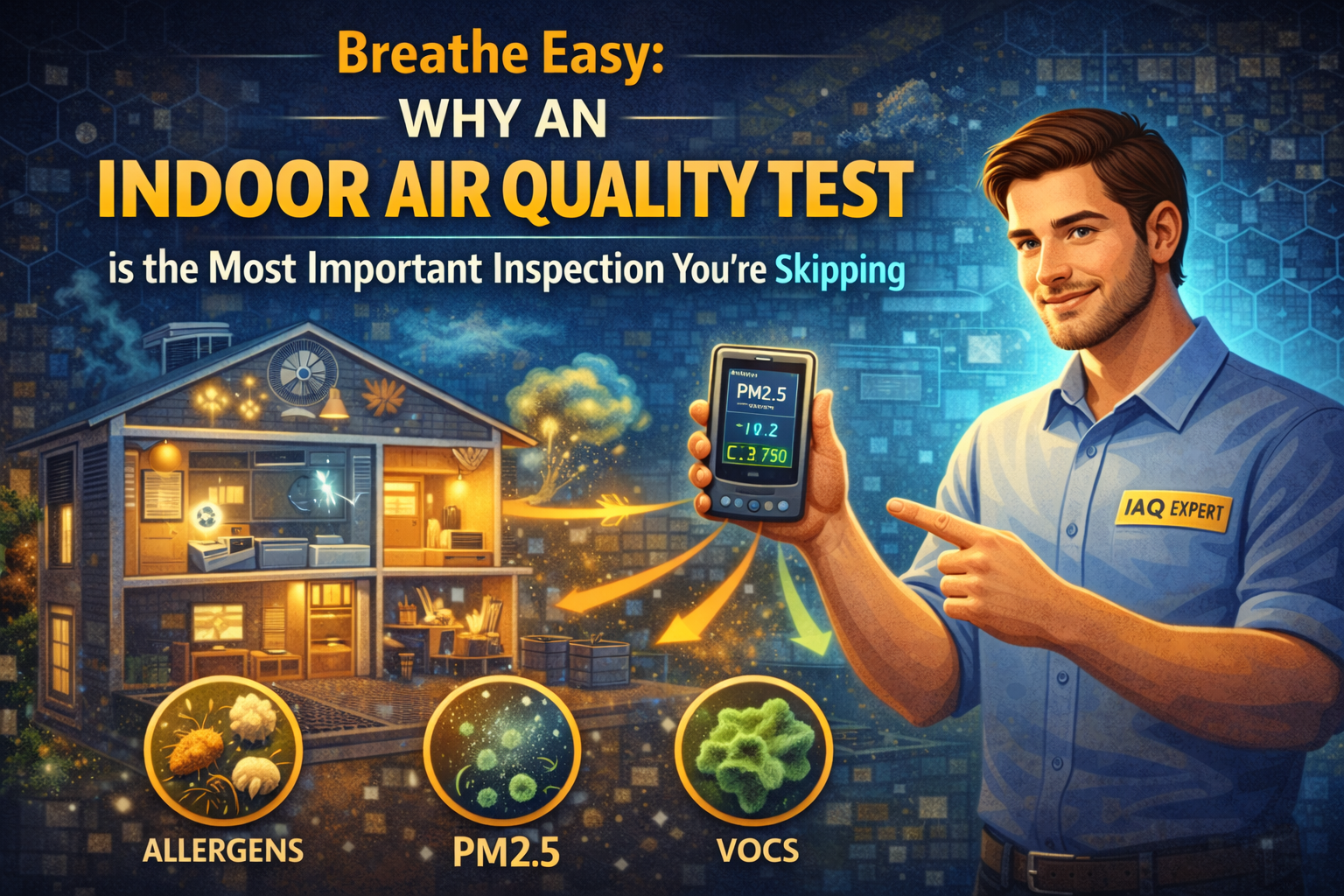
A comprehensive Indoor Air Quality Test looks for a cocktail of invisible triggers. We’re talking about volatile organic compounds (VOCs) from new carpets, formaldehyde from cheap cabinetry, and even carbon monoxide from faulty venting.
In many older homes, the biggest concern is radon. It’s a naturally occurring radioactive gas that seeps up through the foundation. You can’t see it, taste it, or smell it. According to the National Association of Realtors (NAR), buyers are increasingly prioritizing health and wellness features, and a clean Indoor Air Quality Test is becoming a major selling point for savvy homeowners.
Mold: The Silent Value-Killer
I’ve seen dozens of investors walk away from a “perfect” flip because the air samples came back with elevated spore counts. Mold doesn’t always show up as a black patch in the corner of the bathroom. It hides in the HVAC ducts, under the floorboards, and inside the insulation.
If you don’t perform an Indoor Air Quality Test during your due diligence period, you are essentially taking a massive financial gamble. Remediation for hidden mold can easily run into the tens of thousands of dollars. Worse, if you move in and your family starts getting unexplained headaches or respiratory issues, the emotional cost is even higher.
In the real estate world, we call this “latent defect” territory. An Indoor Air Quality Test gives you the leverage to ask the seller for a credit or a professional cleaning before you ever commit to the mortgage. For a deeper look at the legal and health standards surrounding these pollutants, Wikipedia’s entry on Indoor Air Quality provides a great breakdown of the specific particulates and gases that professionals look for during a screening.

The “Tight House” Paradox
You’d think a brand-new, energy-efficient home would have the best air, right? Surprisingly, it’s often the opposite. Modern homes are built to be incredibly “tight” to save on heating and cooling costs. While this is great for your utility bills, it can be a disaster for air circulation.
If a new build doesn’t have a properly functioning Energy Recovery Ventilator (ERV), the air becomes stagnant. Pollutants from cleaning products, cooking, and even off-gassing furniture get trapped inside. This is why I always recommend an Indoor Air Quality Test for new constructions just as much as for century-old homes. You want to ensure that the “thermos” you’re buying has the “lungs” it needs to keep you healthy.
When Should You Be Most Concerned?
While every buyer should consider it, there are certain “red flag” scenarios where an Indoor Air Quality Test is absolutely non-negotiable.
- The “Flip” Property: Be wary of homes that were renovated quickly. Cheap paints, glues, and flooring can release high levels of VOCs for months.
- History of Water Damage: If the disclosures mention a past roof leak or a sump pump failure, you need to check for hidden spores.
- Basement Living Spaces: If you plan on using the basement as an office or bedroom, a radon check is a vital part of your Indoor Air Quality Test.
- Near Industrial Zones: If the home is near a dry cleaner, an old gas station, or a manufacturing plant, soil vapor intrusion can impact the air inside.
I once worked with a buyer who was looking at a charming cottage near an old industrial park. They were worried about the soil, but the Indoor Air Quality Test revealed that the real issue was chemical vapors seeping through the basement floor. That $300 test saved them from a $500,000 mistake.
Using the Results for Negotiation
One of the best things about having a professional Indoor Air Quality Test report in your hand is the power it gives you at the negotiating table. Real estate is about facts, not feelings. If you tell a seller “the air feels stuffy,” they’ll roll their eyes. If you show them a lab report showing elevated formaldehyde levels, they have to listen.
You can use the findings from your Indoor Air Quality Test to:
- Request Professional Remediation: Demand the seller hires a certified specialist to fix the issue.
- Price Reduction: Negotiate a lower sale price to cover the cost of a new ventilation system or mold removal.
- Walk Away: Use the inspection contingency to exit the contract with your earnest money intact if the issues are too severe.
The Environmental Protection Agency (EPA) offers extensive guidelines on what levels of pollutants are considered “safe.” Having these benchmarks during your Indoor Air Quality Test review allows you to make an objective, level-headed decision about your future home.
The Cost vs. The Benefit
I get it—buying a house is expensive. Between the appraisal, the general inspection, and the closing costs, another $250 to $500 for an Indoor Air Quality Test feels like a lot. But you have to put it in perspective.
You are making a thirty-year financial commitment. You are deciding where your children will sleep and where you will spend the majority of your life. Compared to the cost of a lifetime of medical bills or a massive mold remediation project, the price of an Indoor Air Quality Test is the cheapest insurance policy you will ever buy. It’s about peace of mind. It’s about knowing that when you close that front door for the first time, you aren’t just buying a house—you’re buying a healthy home.
FAQ Section
What exactly is included in an Indoor Air Quality Test? A standard professional test usually involves air sampling to check for mold spores, radon, volatile organic compounds (VOCs), carbon monoxide, and particulate matter. Some tests also check for lead dust or asbestos fibers if the home is older.
Can I just use a store-bought DIY kit? DIY kits are a good first step, but they aren’t nearly as accurate as a professional Indoor Air Quality Test. Lab-grade equipment can detect smaller concentrations and provide a much more detailed breakdown of exactly what is in your air and where it might be coming from.
How long does it take to get the results? Most air samples need to be sent to a laboratory for analysis. You can usually expect a full report from your Indoor Air Quality Test within 2 to 5 business days. Radon tests, specifically, often require 48 to 72 hours of monitoring.
What if the Indoor Air Quality Test fails? It doesn’t necessarily mean you shouldn’t buy the house. Most air quality issues have a solution—whether it’s installing a radon mitigation system, upgrading the HVAC filters, or professionally cleaning the ducts. Use the results to negotiate who pays for those fixes.
Is an Indoor Air Quality Test part of a standard home inspection? Usually, no. Most home inspectors do a visual check but do not have the specialized equipment for air sampling. You will likely need to hire a separate specialist or ask your inspector if they offer a professional Indoor Air Quality Test as an add-on service.
Conclusion
At the end of the day, a home is more than just an investment; it’s the environment where your life happens. We spend so much time looking at the kitchen counters and the neighborhood schools that we forget to check the very thing that keeps us alive: the air.
Don’t let the excitement of a new house blind you to potential health risks. Take the time to schedule a professional Indoor Air Quality Test before you sign that final contract. It is a small step that ensures your new beginning is a healthy one. After all, the best homes aren’t just beautiful—they are breathable.
