
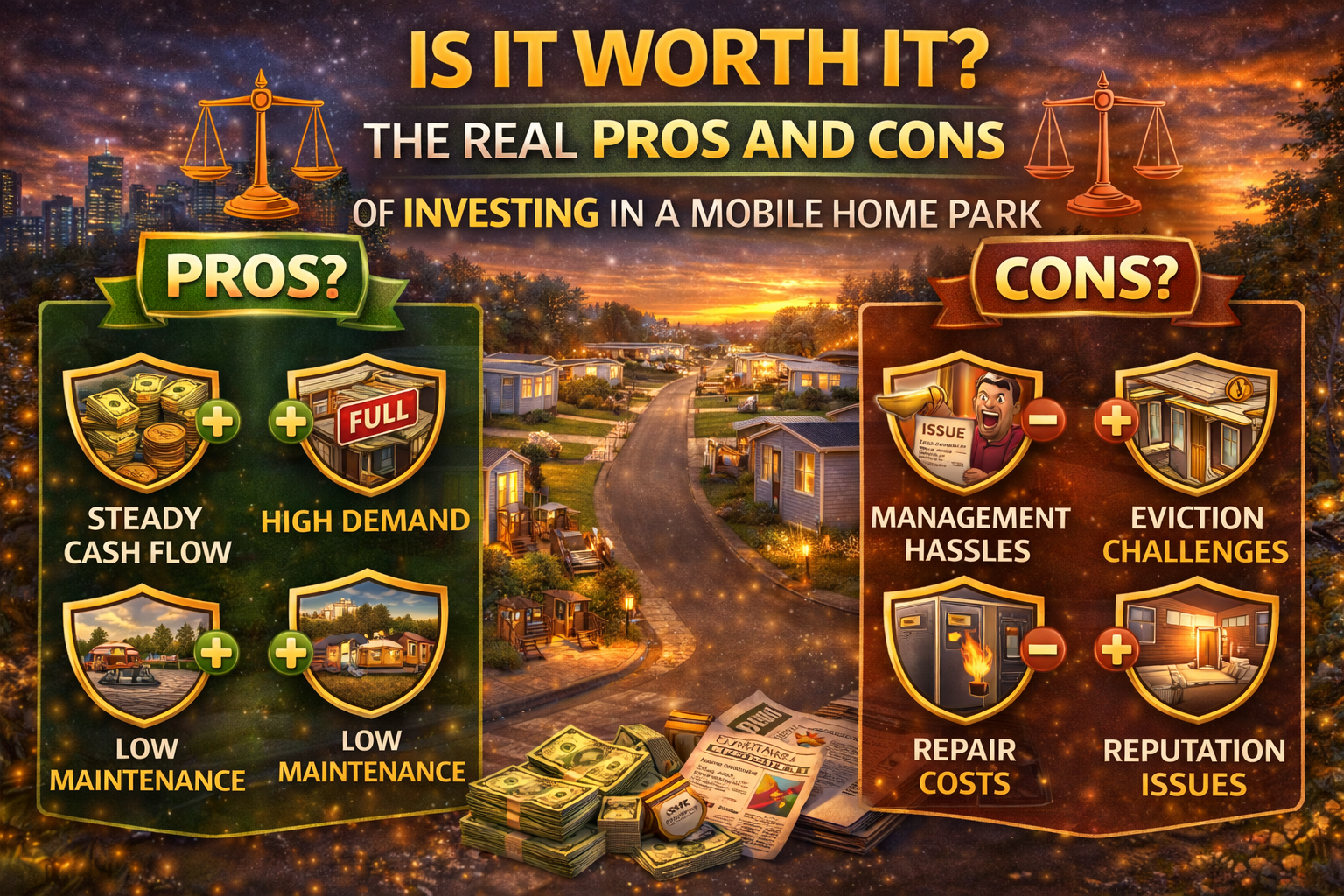
Considering a shift in your portfolio? Explore the honest pros and cons of owning a mobile home park, from high yield potential to unique management hurdles.
Table of Contents
I’ll never forget a conversation I had with an investor friend about five years ago. He was selling off his portfolio of single-family rentals and moving his capital into something most people would overlook: a mobile home park. At the time, I thought he was losing his mind. Why trade “stable” residential homes for a niche that often carries a bit of a social stigma?
Well, a few tax cycles later, the guy is laughing all the way to the bank. It turns out that while everyone else was fighting over overpriced condos and bidding wars on suburban split-levels, he was quietly tapping into one of the most resilient asset classes in the country.
But let’s be real—investing in a mobile home park isn’t exactly a walk in the park. It is a nuanced, hands-on business that requires a very specific temperament. If you are used to the hands-off nature of a REIT or the simplicity of a standard apartment lease, you are in for a bit of a culture shock. This isn’t just about collecting rent; it’s about managing a community and maintaining infrastructure that most people never have to think about.
Why Investors Are Flocking to the Mobile Home Park Model
The biggest draw for any mobile home park investor is the sheer lack of affordable housing in the current market. As stick-built homes become increasingly unattainable for the average worker, demand for manufactured housing has skyrocketed. You aren’t just selling a place to live; you are providing a necessary solution to a national crisis.
One of the unique “pros” is the low maintenance cost per unit. In a typical rental, you are responsible for the roof, the HVAC, the toilets, and the flooring. In a “lot-rent” mobile home park, the tenant usually owns the home. You are essentially just renting them a rectangular patch of dirt and the utility hookups. If their water heater bursts, it is their problem, not yours.
High Yield Potential and Cash Flow
When you look at the capitalization rate (cap rate) of a mobile home park, it often beats out retail, office space, and even multi-family apartments. Because your expenses are primarily related to the land and shared infrastructure—like roads and common areas—your margins can be significantly higher.
Investors also love the “stickiness” of the tenants. Moving a manufactured home is incredibly expensive, often costing $5,000 to $10,000. Because of this, once a tenant moves into your mobile home park, they tend to stay for a very long time. This low turnover rate translates to a very predictable, steady stream of monthly income.
The Challenges: Why It Isn’t All Easy Money
Now, let’s talk about the “cons,” because there are plenty. Managing a mobile home park means you are essentially a small-town mayor. You are responsible for the roads, the streetlights, and often a complex private utility system. If a water main snaps under a driveway in the middle of a February freeze, that is your headache to fix.
Infrastructure issues are the silent killers of profit in this niche. Many older properties weren’t built with modern materials. If you buy a mobile home park that still has galvanized pipes or a failing septic system, your initial “bargain” purchase price will quickly be eclipsed by six-figure repair bills.
Financing and Zoning Hurdles
Getting a loan for a mobile home park is a different beast compared to a standard residential mortgage. While agencies like Fannie Mae and Freddie Mac have become more active in this space, many local banks are still hesitant. You’ll often need a larger down payment and a solid track record to get the best terms.
Then there is the zoning issue. Most municipalities are not exactly rolling out the red carpet for a new mobile home park. In fact, many cities have active “not in my backyard” (NIMBY) policies that make it nearly impossible to develop new parks. While this makes your existing mobile home park more valuable due to limited supply, it also makes it harder to expand or find new deals.
Infrastructure and Maintenance Realities
When you take over a mobile home park, you need to do a deep dive into the utility billing. Are the tenants sub-metered for water and electricity, or are you paying a flat master-metered bill? In my experience, sub-metering is a game-changer. It encourages conservation and shifts the utility burden to the actual users, protecting your bottom line.
Maintaining a mobile home park also requires a delicate balance of community management. You want to keep the park looking clean and respectable to maintain property value, but you also have to work with tenants who may be on fixed incomes. It requires a level of empathy and firm boundary-setting that isn’t always taught in real estate seminars.
According to the National Association of Realtors (NAR), the commercial sector for manufactured housing has remained remarkably stable even during economic downturns. This stability is why a mobile home park is often considered “recession-resistant.” When the economy dips, people move into affordable housing, not out of it.
The Strategy: Park-Owned vs. Tenant-Owned Homes
One of the biggest debates in the industry is whether to own the homes or just the land. Owning the homes in your mobile home park allows you to charge higher rent, but it also means you are responsible for all the interior repairs.
Most seasoned investors prefer the land-lease model. In this scenario, the mobile home park owner only manages the “pads.” This “dirt-only” strategy is what allows for the high-margin, low-headache scaling that makes this asset class so attractive. If you find a park where the majority of residents own their units, you have likely found a goldmine of stability.
You can find more on the historical development of these communities and their legal classifications on Wikipedia’s Manufactured Housing entry. Understanding the difference between a pre-1976 mobile home and a modern manufactured home is vital for insurance and lending purposes when evaluating a mobile home park.
Environmental and Legal Considerations
Before you sign on the dotted line for a mobile home park, you need to perform rigorous due diligence. This includes a Phase I Environmental Site Assessment. You need to know if there were old fuel tanks buried on-site or if the soil is contaminated.
Legal compliance is another big one. Tenant-landlord laws for a mobile home park are often different from standard apartment laws. Some states have strict rent control or specific eviction procedures that favor the tenant. If you don’t know these laws inside and out, a single legal dispute can tie up your cash flow for months.
Investing in a mobile home park also means dealing with the stigma I mentioned earlier. You may face pushback from local councils when trying to make improvements or raise lot rents. It’s a business that requires a thick skin and a long-term vision.
FAQ Section
Is a mobile home park a good investment for beginners? It can be, but the learning curve is steep. It is generally better for someone who already has experience in property management or commercial real estate. The infrastructure management (sewer, water, electric) makes it more complex than a single-family home.
How do I find a mobile home park for sale? While some appear on the MLS, many of the best deals are found through commercial brokers or by direct mail marketing to existing owners. Many parks are owned by “mom and pop” operators who are ready to retire but haven’t listed the property publicly.
What is lot rent? Lot rent is the fee a tenant pays to the mobile home park owner for the use of the land, the utility hookups, and access to community amenities. The tenant typically owns the home itself but “leases” the space it sits on.
Can I use a traditional mortgage to buy a mobile home park? No. You will need a commercial real estate loan. Lenders will look at the Debt Service Coverage Ratio (DSCR) and the overall condition of the park’s infrastructure before approving the financing.
Are mobile home parks recession-proof? No investment is 100% recession-proof, but a mobile home park is widely considered recession-resistant. Because it represents the lowest-cost detached housing option, demand usually remains high even when the broader economy struggles.
Conclusion
At the end of the day, a mobile home park is a high-yield, high-impact investment that serves a critical need in our society. It offers a level of cash flow and stability that is hard to find in other sectors of the real estate market. However, you have to be willing to get your hands dirty—metaphorically and sometimes literally.
If you are looking for a passive investment where you never have to think about sewer lines or zoning boards, this probably isn’t the path for you. But if you want to build a resilient, cash-flowing portfolio that provides genuine value to the community, a mobile home park could be the smartest move you ever make.
