
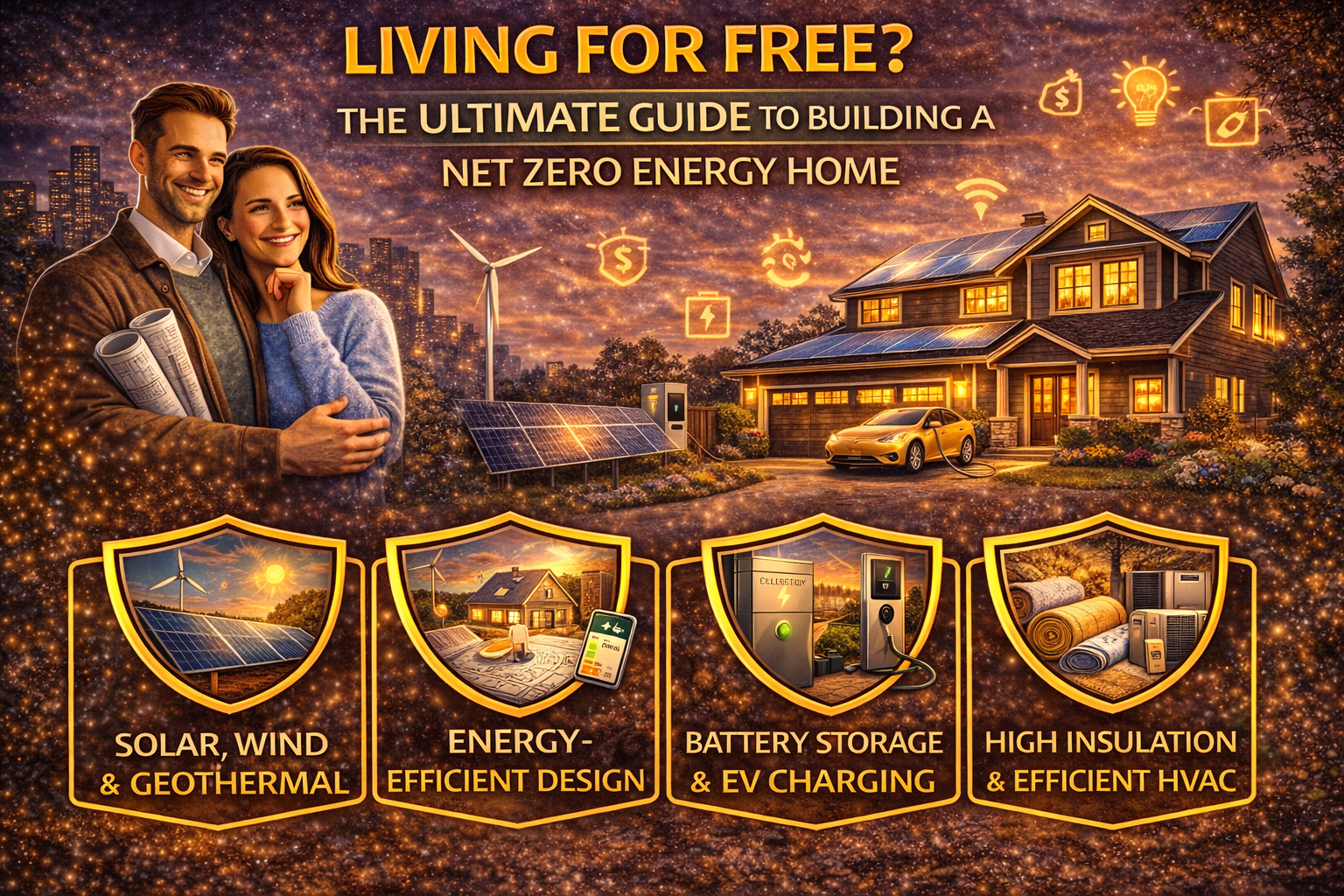
Ready to delete your utility bills? Learn the secrets of building a Net Zero Energy Home, from airtight envelopes to solar arrays, and boost your property value.
Table of Contents
I’ll never forget the first time I sat down with a couple who wanted to build their “forever home” in the Pacific Northwest. They didn’t just want a pretty kitchen and a three-car garage; they wanted a house that wouldn’t send them a bill every month. They were tired of fluctuating heating costs and the feeling that their hard-earned money was literally leaking out through the window frames.
That was my deep-dive introduction into the world of the Net Zero Energy Home.
On the surface, the concept sounds almost like science fiction: a house that produces as much energy as it consumes over the course of a year. But as a real estate strategist, I can tell you it is becoming a very tangible reality for homeowners who are looking for long-term financial security and environmental peace of mind. Building a Net Zero Energy Home isn’t about living in a dark cave or sacrificing luxury; it’s about incredibly smart engineering and high-performance design that works silently in the background.
The Foundation: It Starts with the Envelope
If you want to reach the goal of a Net Zero Energy Home, you have to stop thinking about your house as a collection of rooms and start thinking about it as a thermos. If you put hot coffee in a cheap plastic cup, it’s cold in ten minutes. If you put it in a high-quality vacuum-sealed thermos, it stays hot all day.
The “envelope” of your home—the walls, the roof, and the foundation—is the most critical component. Most traditional houses are incredibly leaky; if you added up all the tiny cracks around your outlets, windows, and baseboards, it would be like leaving a medium-sized window wide open all year round. In a Net Zero Energy Home, we use advanced framing techniques and spray foam or rigid board insulation to create an airtight seal.
Windows are the traditional weak point, but modern triple-pane glass has changed the game. When you invest in a high-performance envelope, you drastically reduce the “load” on your heating and cooling systems. This is the first and most important step toward making a Net Zero Energy Home viable; you can’t just slap solar panels on a drafty house and expect it to work.
Orienting for the Sun: Passive Solar Design
One of the oldest tricks in the book is also the most effective for a Net Zero Energy Home. It’s called passive solar orientation. By simply pointing the longest side of your house toward the south (in the northern hemisphere), you can use the sun’s natural heat to warm your home in the winter for free.
I’ve seen builders incorporate “thermal mass” like polished concrete floors or stone walls that soak up that afternoon sun and slowly release it as the temperature drops at night. Conversely, well-placed overhangs or deciduous trees can provide shade in the summer, preventing the Net Zero Energy Home from overheating. It’s a low-tech solution that saves thousands in mechanical costs over the life of the property.
High-Efficiency Mechanicals: The Lungs of the House
Since a Net Zero Energy Home is built so tightly, you can’t rely on “natural” drafts for fresh air. You need a dedicated mechanical system to keep the air healthy. Most builders use an ERV (Energy Recovery Ventilator) or an HRV. This device acts like the lungs of the house, bringing in fresh filtered air while “recycling” the heat from the stale air it’s exhausting.
For heating and cooling, the standard choice for a Net Zero Energy Home is an air-source heat pump. These systems are incredibly efficient compared to old-school gas furnaces or electric baseboards. They don’t “create” heat; they just move it from one place to another. Pair this with a heat pump water heater, and you’ve eliminated the need for fossil fuels entirely.
According to the National Association of Realtors (NAR), buyers are increasingly willing to pay a premium for high-performance features that lower their cost of ownership. A Net Zero Energy Home is the ultimate expression of that value proposition.
Generating Your Own Power: The Solar Component
Once you’ve reduced your energy needs to a bare minimum, it’s time to produce the power you actually do use. This is where the solar array comes in. In a properly designed Net Zero Energy Home, the roof is angled perfectly to catch the maximum amount of sunlight.
Most people use a “grid-tied” system. During the day, your solar panels produce more electricity than you need, and that excess flows back into the municipal grid (often spinning your meter backward). At night, you pull power back from the grid. Over 12 months, the net result is zero. For a deeper look at the technical standards of these systems, Wikipedia’s entry on Zero-energy Buildings provides a fantastic overview of the international certification levels.
The Real Estate Value: Is It Worth the Investment?
Let’s talk about the “green” that matters most to many: your wallet. Building a Net Zero Energy Home typically costs about 5% to 10% more than a standard code-built house. However, you have to look at the total “monthly cost of ownership.”
If your mortgage is $150 higher because of the energy-efficient upgrades, but your electric and gas bills are $250 lower, you are essentially $100 “in the black” from the very first month. Plus, you’ve insulated yourself from future energy price hikes. In the luxury real estate market, we are seeing Net Zero Energy Home properties sell faster than their traditional counterparts because they represent a “future-proofed” investment.
Smart Home Integration and Energy Monitoring
You can’t manage what you don’t measure. Most modern versions of a Net Zero Energy Home come equipped with real-time energy monitoring systems. These allow the homeowner to see exactly how much power their appliances are drawing.
I’ve had clients tell me that once they saw the “cost” of leaving their old plasma TV on all day, they changed their habits instantly. This feedback loop is essential. A Net Zero Energy Home is a partnership between the structure and the inhabitants. Simple things like choosing Energy Star appliances and LED lighting are the final “easy wins” that bridge the gap to zero.
FAQ Section
How much more does it cost to build a Net Zero Energy Home? On average, expect a 5% to 15% increase in initial construction costs. This covers extra insulation, high-performance windows, and the solar array. However, most homeowners find that the monthly utility savings pay back that “green premium” within 8 to 12 years.
Does a Net Zero Energy Home work in cold climates? Absolutely. In fact, they are often more comfortable in cold climates because the superior insulation and airtightness eliminate cold drafts and hot spots. With modern heat pump technology, a Net Zero Energy Home can stay warm even when temperatures drop well below freezing.
What is the difference between Net Zero and Net Zero Ready? A “Net Zero Ready” home has all the high-performance features (insulation, airtightness, efficient appliances) but hasn’t had the solar panels installed yet. It is essentially “pre-plumbed” so that the owner can add solar later and reach the goal of a Net Zero Energy Home.
Can I convert my existing house into a Net Zero Energy Home? It is possible but very challenging. A “deep energy retrofit” involves stripping a house to the studs to add superior insulation and an air barrier. While expensive, it can drastically improve the comfort and value of an older home.
Do I need batteries for a Net Zero Energy Home? Not necessarily. Most owners stay connected to the utility grid, using it like a giant battery. However, adding a battery system (like a Tesla Powerwall) allows you to stay powered up during grid outages and maximizes your independence.
Conclusion
At the end of the day, building a Net Zero Energy Home is about more than just being “green.” It is a strategic financial move that protects you from the rising cost of living while providing a level of comfort that a standard house simply can’t match.
The market is shifting. Buyers are getting smarter, and energy regulations are getting tighter. Whether you are building from scratch or looking for a high-performance listing, a Net Zero Energy Home represents the gold standard of modern residential real estate. It’s an investment in your future, your comfort, and your peace of mind.
